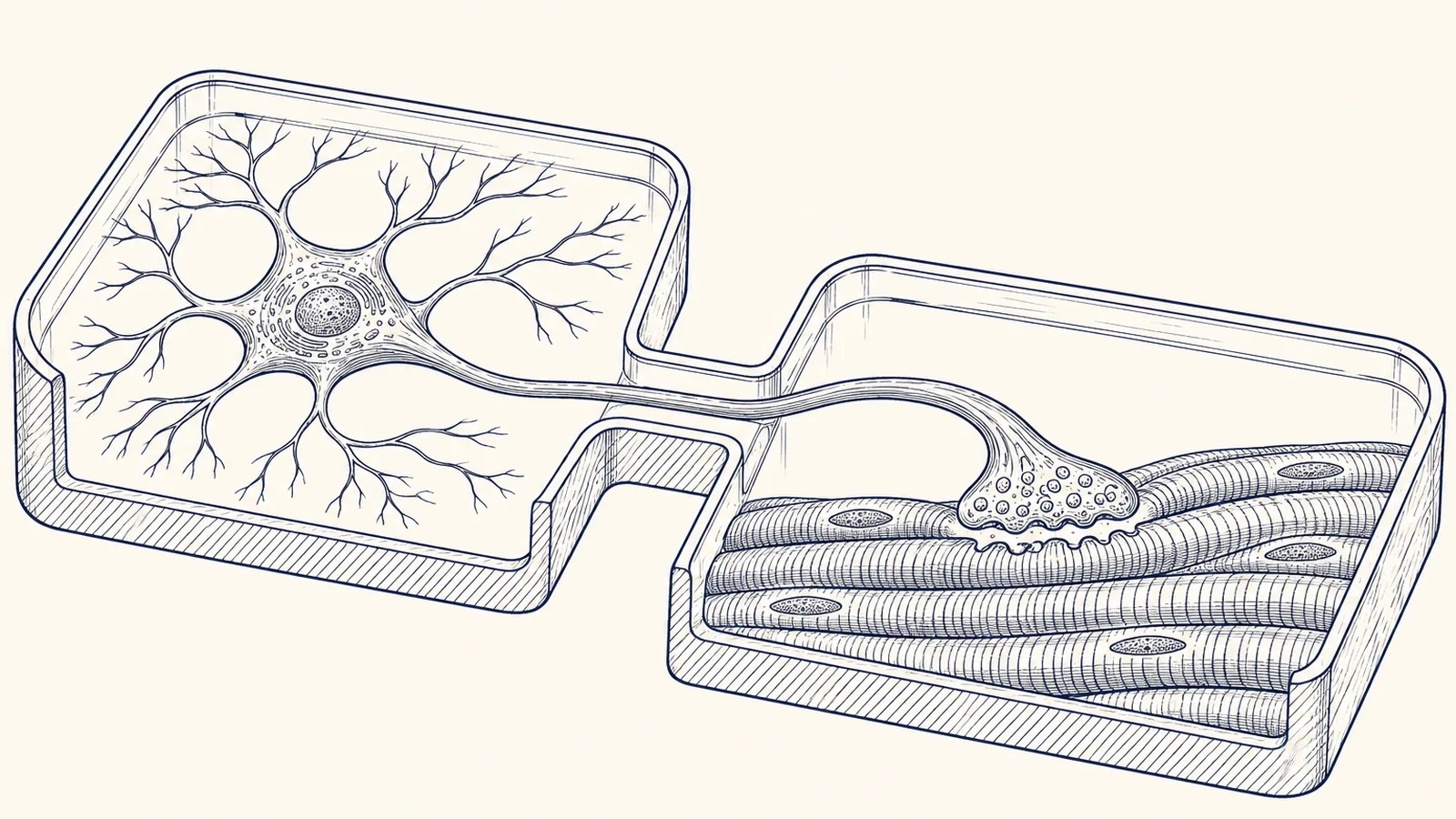
I’ve filed Alzheimer’s under memory for so long that this result stopped me cold. A healthy human muscle was wired to motor neurons carrying inherited Alzheimer’s mutations, with no brain or spinal cord anywhere in the system, and when the neurons fired, the muscle often failed to answer, even though it contracted fine when the researchers stimulated it directly.
That’s the setup from researchers at the University of Central Florida and Hesperos, the company that makes the platform. They built a tiny neuromuscular junction, the point where a motor neuron hands its signal to a muscle fiber, on a two-chamber chip with healthy human muscle cells in one chamber and stem-cell-derived motor neurons in the other. The work was published in Alzheimer’s & Dementia in April, and UCF pushed it out again this week under the headline “Alzheimer’s may have early warning signs outside the brain.”
I’ll be honest about where I started. A chip study whose senior author is the chief scientist of the company selling the chip, recirculated seven months later with a premonition-flavored headline, had me reaching for the salt before I finished the press release. What changed my mind was the experimental design, which is cleaner than the headline deserves.
The paper used motor neurons from a single patient with the PSEN1 A246E mutation, plus a second line edited to carry the Swedish APP mutation (K595N/M596L). The APP line is the tidier comparison, measured against its own unedited parent line. The PSEN1 neurons were measured against neurons from a different, healthy donor, so some of their differences could come from the donor rather than the mutation. Both mutations cause familial Alzheimer’s, the rare inherited form that typically begins between 40 and 65.
The team zapped the neurons and filmed the muscle, scoring two things a clinician would recognize: fidelity, meaning how reliably a nerve pulse produced a contraction, and a fatigue index for how fast the muscle gave out under rapid stimulation. They tested on days 11, 17 and 23 after plating, across three experimental repeats. The PSEN1 neurons fell short on fidelity at every stimulation frequency on all three test days, and their muscles tired faster at 2 Hz, significantly so on days 11 and 17. The APP neurons were milder, with a fidelity deficit on day 17 that had slipped below statistical significance by day 23. Junctions formed in roughly normal numbers. They just worked worse.
When the researchers bypassed the nerve and stimulated the muscle directly, it showed no deficit at any frequency on any day. That rules out a broken muscle and points at the handoff, most likely the nerve side of it, though a system this pared down can’t fully exclude trouble in how the muscle receives the signal.
Wait, why would an amyloid gene jam a nerve ending?
This is where I got hooked. PSEN1 and APP are the classic amyloid genes, famous for what they do to plaques in the brain, and the nerve endings modeled here would sit in your calf. So what are those genes doing down there?
Both mutant lines carried more Rab5-positive early endosomes than healthy neurons on days 11 and 17, a result from two experimental repeats. Endosomes are the cell’s sorting and recycling depots, and a nerve terminal leans on that recycling to keep its signaling gear stocked. If those depots are backing up like a jammed loading dock (a hypothesis the authors raise and did not test), you’d expect a nerve that stumbles at firing a muscle over and over, which is exactly the measure that failed. The PSEN1 neurons also swung electrically, less excitable than normal at days 6 and 19 and more excitable at day 12. None of this proves the endosomes cause the deficit, but it does show that in these motor neurons, mutations in amyloid-processing genes make trouble with no brain involved.
The drug test ran on the PSEN1 junctions only. Memantine and galantamine, two standard Alzheimer’s medications, failed to improve fidelity, fatigue, junction number or stability. Galantamine was the more intriguing candidate because it slows the breakdown of acetylcholine, the chemical a motor neuron uses to tell a muscle to fire, and the team tried it on the neuron side and the muscle side of the chip without rescuing either. “It means drugs that target the brain may not fix problems in the rest of the body,” Hickman told UCF, a broad conclusion to hang on two drugs tested in one cell line.
Your walk has been dropping hints for years
Clinicians have long watched the body change early in cognitive decline. In the Oregon Brain Aging Study, 204 healthy seniors followed for up to 20 years saw their walking speed start falling faster about 12 years before they were diagnosed with mild cognitive impairment. The new paper also cites a 12-year UK Biobank analysis in which people who went on to develop dementia had slower gait and weaker grip at baseline. The usual reading treats those signs as downstream of a struggling brain. The chip can’t explain why the Oregon seniors slowed down, and it doesn’t try. What it adds is a possibility: in inherited Alzheimer’s, at least, the motor circuit has a way to fail on its own. “You can’t move unless the motor circuit works,” Hickman said. Co-author Xiufang Guo went further, saying motor deficits “may be an earlier indication” of the disease.
That boldness comes with a funding context. In April 2025 the NIH announced it would prioritize human-based research technologies, tissue chips among them, and said animal-model results had translated inconclusively to human diseases including Alzheimer’s. Human cells on a chip, no mouse involved, is the kind of work that shift rewards, and it happens to be the product Hesperos sells. One of the two NIH grants behind this paper, R44AG071386, comes from the agency’s small-business innovation program.
Who gets paid if the chip is right
Hickman isn’t only a UCF professor. The paper’s disclosure says Hickman has an ownership interest in, and is Chief Scientist and a board member of, a company that may benefit financially from the results. Every other author, per the same conflict-of-interest statement, declares no financial interests. The Hesperos write-up lists him as its Chief Scientist and quotes an unnamed journal reviewer calling the finding “of high significance,” on a website whose menu carries a “Get a Quote” link. None of that makes the data wrong. It does mean the loudest voice calling this a turn for the field belongs to the company that sells the platform.
The headline outruns the science, too. UCF’s own release concedes the experiments do not establish that these changes necessarily occur before memory loss in patients, and a dish has no human lifetime to compare against. The paper measured nothing in a brain, so its claim of nerve deficits independent of the central nervous system is an inference. What it shows is that the deficit can arise without a brain present, which is a much weaker statement than saying it arises independently in a living person.
The model leaves out Schwann cells and astrocytes, never tested amyloid-beta itself, and tried the drugs only on the PSEN1 line. The authors note those missing support cells could soften the damage or make it worse. And both mutations cause familial Alzheimer’s, while most patients have the common late-onset form, which this chip never modeled.
That’s the experiment I want next: build the same chip from the motor neurons of people with ordinary late-onset Alzheimer’s and see whether the signal still fails. Until somebody runs it, I’m not reading a slower walk as an Alzheimer’s symptom, and I won’t let anyone, Hesperos included, sell me a nerve-on-a-chip as an early-warning test.
Sources
- Kargazhanov et al., Alzheimer’s & Dementia (2026)
- University of Central Florida via ScienceDaily, “Alzheimer’s may have early warning signs outside the brain” (November 2026)
- Buracchio et al., Archives of Neurology (2010)
- NIH, “NIH to prioritize human-based research technologies” (April 29, 2025)
- Hesperos, Alzheimer’s NMJ publication announcement (2026)