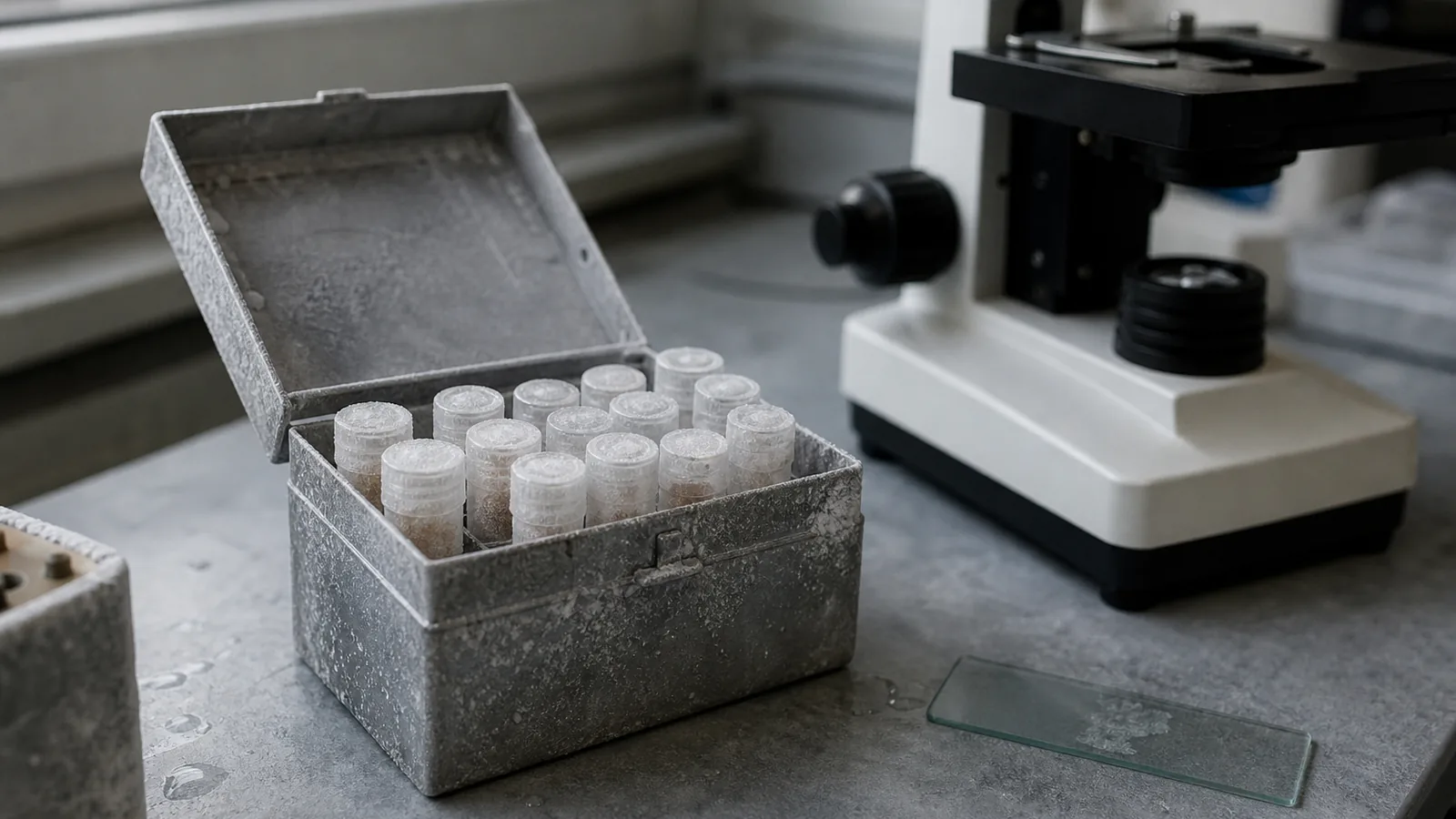
I went in expecting another “scientists discover” Alzheimer’s press cycle and wound up with a paper I want to sit with. An ETH Zurich team led by Ursula Quitterer just published, in Cell Reports Medicine, a feedback-loop picture of the disease that quietly moves amyloid out of the driver’s seat. Their starting point, almost twenty years back, was a freezer of brain tissue a Cairo neurosurgeon shipped them: dementia patients and controls, harvested during tumor surgery at Ain Shams University Hospital. She was hunting one protein. She just named it: GRK2.
The mechanism is the part worth slowing down for. GRK2 sits inside nerve cells in two forms, active and inactive. The inactive copies, the team found, clump together and physically lodge in the pores of mitochondria, the cell’s power plants. Plug those pores and the cell can’t make energy. Inactive GRK2 itself drives the cell to produce more amyloid beta, the protein the entire pharmaceutical industry has spent thirty years and tens of billions of dollars trying to scrub out. The extra amyloid then triggers more GRK2 aggregating, which plugs more mitochondria. It’s a feedback loop, and GRK2 is the upstream knob amplifying it.
Quitterer’s team then screened compounds for one that would block the aggregation without scrambling the rest of GRK2’s day job. They settled on the molecule they’re calling Compound 10. In transgenic Alzheimer’s mice it slowed nerve cell death, reduced amyloid beta deposits, and the animals lived longer. Their hearts looked better in old age. They got fewer gray hairs. The ETH press release leans on the gray-hair line, which is cute, but the heart finding is what I would underline twice. GRK2 lives in cardiac tissue too, and the failing energy supply that wrecks an Alzheimer’s neuron looks a lot like the failing energy supply that wrecks a failing heart. If you take the mitochondrial-plug picture seriously, “Alzheimer’s drug” might be too narrow a label.
Now compare this to the version the FDA and the industry have been selling. The amyloid-clearing antibodies the agency approved with great fanfare, Eisai and Biogen’s lecanemab and Eli Lilly’s donanemab, do strip plaques effectively. Patients still decline, and the cognitive benefit is small enough that clinicians keep arguing about whether a family would even notice. Brain swelling or brain bleeds, what the trials call ARIA, are not rare. Lecanemab’s label reports ARIA-E in 13 percent and ARIA-H in 17 percent of treated patients in its pivotal study; donanemab’s original-dosing label reports ARIA-E in 24 percent and ARIA-H in 31 percent. The European Medicines Agency rejected lecanemab in July 2024, then in November narrowed it to patients carrying one or no copy of the ApoE4 gene, where the safety arithmetic looked less ugly. The shorthand inside the field is that the plaques came down and the disease kept going.
The Zurich work is a clean rebuke to that strategy, though not in the strong form that gets shouted on Twitter. It does not say amyloid is irrelevant. It says amyloid is one half of a loop, and the more interesting place to hit the loop is upstream, at the protein that strangles the cell’s energy supply and triggers more amyloid in the bargain. The biology lines up with a growing pile of mitochondrial-dysfunction findings in early Alzheimer’s that the amyloid orthodoxy has spent years discounting as downstream noise. It hands the contrarians something they have been short on: a concrete molecular target, a feedback-loop diagram that explains how plaques actually pile up, and a drug-like molecule that hits the target.
Then there’s the cold water. Everything above happened in mice. There is no human dosing, no human safety data, no toxicology readout. GRK2 has jobs throughout the body, including in the heart, and a small molecule that interferes with how the protein assembles with itself could behave very differently in a person than in a transgenic line bred to dump amyloid. ETH has filed a patent on Compound 10 and is, in Quitterer’s own words, looking for a pharma partner to develop it. The road from a preclinical readout to a pill that helps your grandmother is the road that ate the antibody class’s cognitive benefit alive.
What I’d watch next is whether a serious pharma partner actually picks Compound 10 up, or whether it sits on the shelf the way most promising preclinical Alzheimer’s molecules do. The big amyloid franchises sank so much capital into the wrong place to push first that a wholesale pivot to mitochondrial mechanisms is the kind of admission the majors are constitutionally bad at making. If a smaller biotech grabs the patent, that’s the more telling signal. I’d also watch for an independent group, on a different Alzheimer’s mouse line, reproducing the Compound 10 result, because a finding nobody else can replicate is not yet a finding, it’s a hope.
The biology, though, is not thin. The picture Quitterer’s team draws, of Alzheimer’s neurons as cells running out of energy because their power plants have been physically clogged, is the picture the failed antibody drugs have been quietly admitting for years without admitting it. Compound 10 may or may not be the molecule that lands. The map is worth the read.
Sources
- Abd Alla J et al., Cell Reports Medicine 2026 – Analysis of GRK2 aggregation in the pathology of Alzheimer disease in animal models (doi:10.1016/j.xcrm.2026.102707)
- ETH Zurich – New drug could slow the development of Alzheimer’s (2026)
- ScienceDaily – Scientists found a new Alzheimer’s trigger and a drug that stops it (2026)
- Neuroscience News – New Compound Blocks Nerve Cell Death in Alzheimer’s (2026)
- Undark – Why Alzheimer’s Scientists Are Re-thinking the Amyloid Hypothesis (2025)