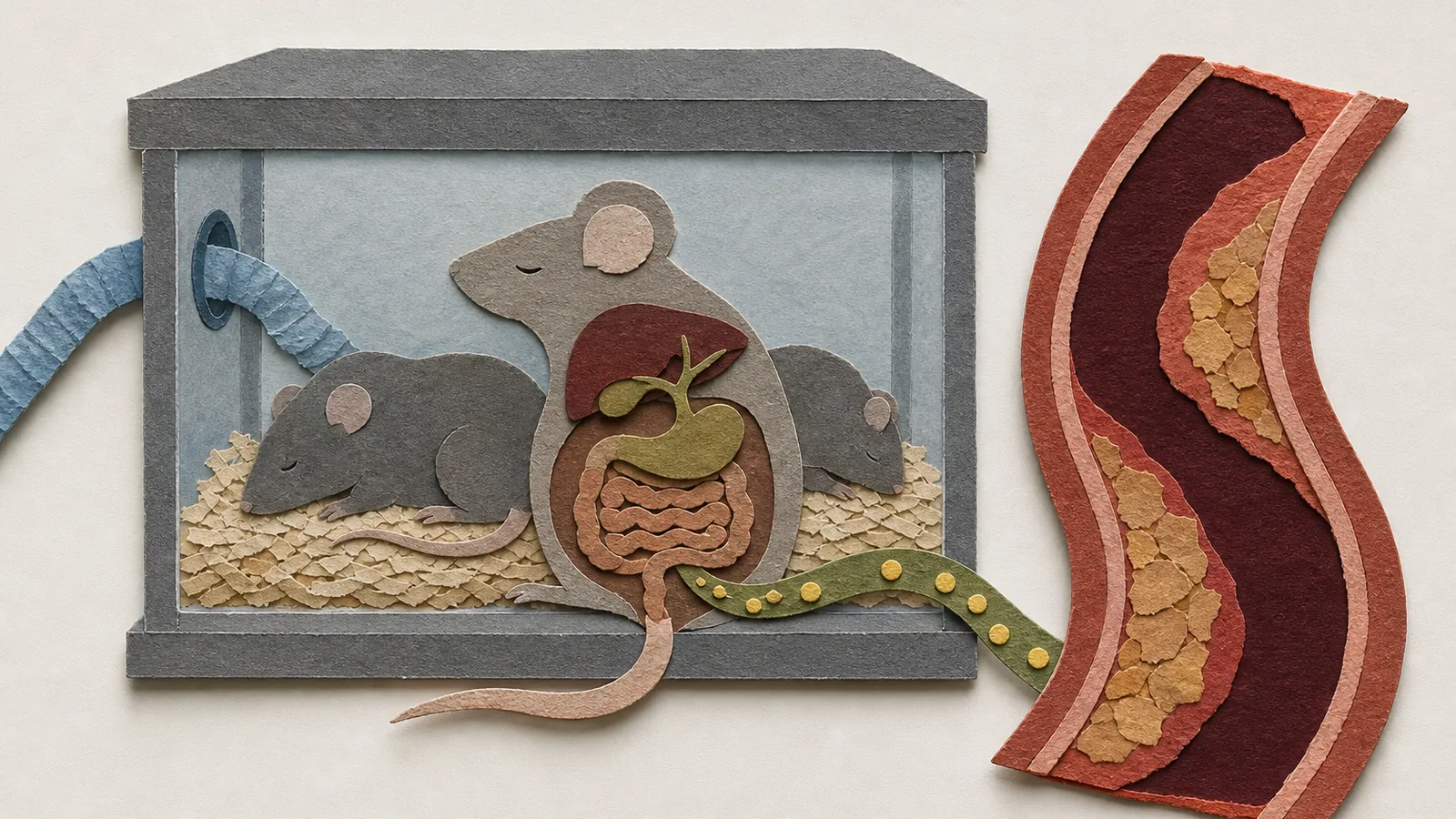
In a chamber at UC San Diego, two strains of plaque-prone mice spent ten weeks breathing the closest thing a cage can deliver to a human night of sleep apnea: oxygen falling and carbon dioxide climbing every few minutes through their light cycle. One strain piled up arterial plaque on schedule. The other, with a single additional knockout, the gut-liver bile-acid receptor FXR, did not. The vascular damage the field has spent twenty years blaming on the airway largely vanished when the researchers disabled a sensor that lives nowhere near it.
That matters because the airway story has not been holding up. For about twenty years, the cardiology line on obstructive sleep apnea has run as a tidy parable. Your airway collapses at night, your blood-oxygen drops, your sympathetic nervous system fires, your heart pays the bill. Strap on a CPAP mask, push pressurized air, buy yourself fewer infarctions. A tidy mechanism, a tidy device, a tidy industry.
When the field finally got around to running the trial that was supposed to prove the heart benefit, the heart benefit refused to appear. The SAVE trial in NEJM, the largest randomized study of CPAP in patients with established cardiovascular disease and moderate-to-severe obstructive sleep apnea, found that adding the mask to usual care did not reduce major cardiovascular events. The Yu et al. meta-analysis published in JAMA the next year, pooling ten randomized trials, reached the same flat line: no significant reduction in major cardiovascular events, stroke, myocardial infarction, or cardiovascular mortality. Observational studies kept singing the older song, but the randomized record was clear.
So what was the airway actually doing to the heart, if not what we thought?
The UCSD group is now pointing the answer at the gut. At ASM Microbe 2026, Celeste Allaband, a veterinary scientist in Rob Knight’s microbiome lab, presented work her group had already posted as a bioRxiv preprint earlier this year under a title only a microbiologist could love: “Farnesoid X receptor-dependent microbiome-bile acid signaling mediates obstructive sleep apnea-induced atherosclerosis.” The press release was breezier: sleep apnea’s hidden heart disease trigger found in the gut.
The experiment was a clean knockout of the kind mouse biologists like. Start with ApoE-deficient mice, the workhorse model for human plaque, and a second strain missing both ApoE and the farnesoid X receptor, or FXR, which sits in the gut and liver and reads bile acids that intestinal microbes have rebuilt. Feed both groups a high-fat, high-cholesterol diet for ten weeks. Half live in room air. The other half live in a chamber cycling low oxygen and elevated carbon dioxide every few minutes during their light cycle. Then count the plaque by Sudan IV staining and sequence the gut.
The apnea conditions accelerated aortic atherosclerosis in the ordinary ApoE mice, and knocking out FXR abolished that acceleration in the aorta and aortic arch. Pulmonary-artery plaque persisted in the double knockouts, a tell that more than one circuit is in play. Alongside the structural finding, the apnea conditions reshaped the gut microbiome itself, enriching bacterial taxa that modify bile acids and changing the chemical signals those modified bile acids send back to the host. Pull out the receptor that hears the signal, and the worst of the vascular damage does not happen.
This is preclinical work, in mice, presented from a meeting stage, anchored to a preprint that has not yet been through peer review. The microbiome field is famous for findings that look explanatory in a mouse cage and behave differently in a human gut, where the resident community is older, more diverse, and shaped by decades of diet, antibiotics, and infection. The pulmonary plaques that survived FXR removal are themselves a warning that bile-acid signaling is at most a major lever, not the only one. Per the ASM release, Allaband’s group plans to test whether bile-acid supplementation or specific probiotic strains can reproduce the protective effect without the genetic surgery, which is the right question and a long road.
Mouse studies find new targets every week, and most go nowhere. The airway story, the one this one would replace, has been faltering on its own. The cardiology field spent two decades framing CPAP as cardiovascular protection, and the randomized record now reads more like a device that improves sleep and daytime alertness without lowering the cardiovascular ledger. Those are benefits worth having. They are not the cardiovascular protection that was sold, and on which nearly 30 million Americans are estimated to have obstructive sleep apnea, with roughly 80 percent of cases still undiagnosed. If the cardiovascular damage runs primarily through a gut-bile-acid axis that no airway pressure ever touches, the trial record stops being an embarrassment to the model and starts being a confirmation of a different one.
None of which changes a single thing for a patient tonight. A personalized bile-acid cocktail is not available at the pharmacy counter. The FDA has not received an application. The microbiome companies that promised cardiovascular relief from probiotics have, so far, mostly delivered annual reports. But the next time a cardiologist tells a newly diagnosed apnea patient that the mask will protect their heart, and that the science is settled, it is worth knowing that the largest randomized trial and its meta-analysis both say otherwise, and that the people actually working on the mechanism have started pointing somewhere else entirely.
Sources
- ASM press release – Study Reveals New Target for Treating Sleep Apnea (ASM Microbe 2026)
- Xue, Allaband, Knight et al. – Farnesoid X receptor-dependent microbiome-bile acid signaling mediates obstructive sleep apnea-induced atherosclerosis (bioRxiv preprint, 2026)
- McEvoy et al. – CPAP for Prevention of Cardiovascular Events in Obstructive Sleep Apnea (SAVE trial), NEJM 2016
- Yu et al. – Association of Positive Airway Pressure With Cardiovascular Events and Death in Adults With Sleep Apnea: A Systematic Review and Meta-analysis, JAMA 2017
- ScienceDaily – Sleep apnea’s hidden heart disease trigger found in the gut
- American Academy of Sleep Medicine – national indicator report on OSA prevalence and undiagnosed cases