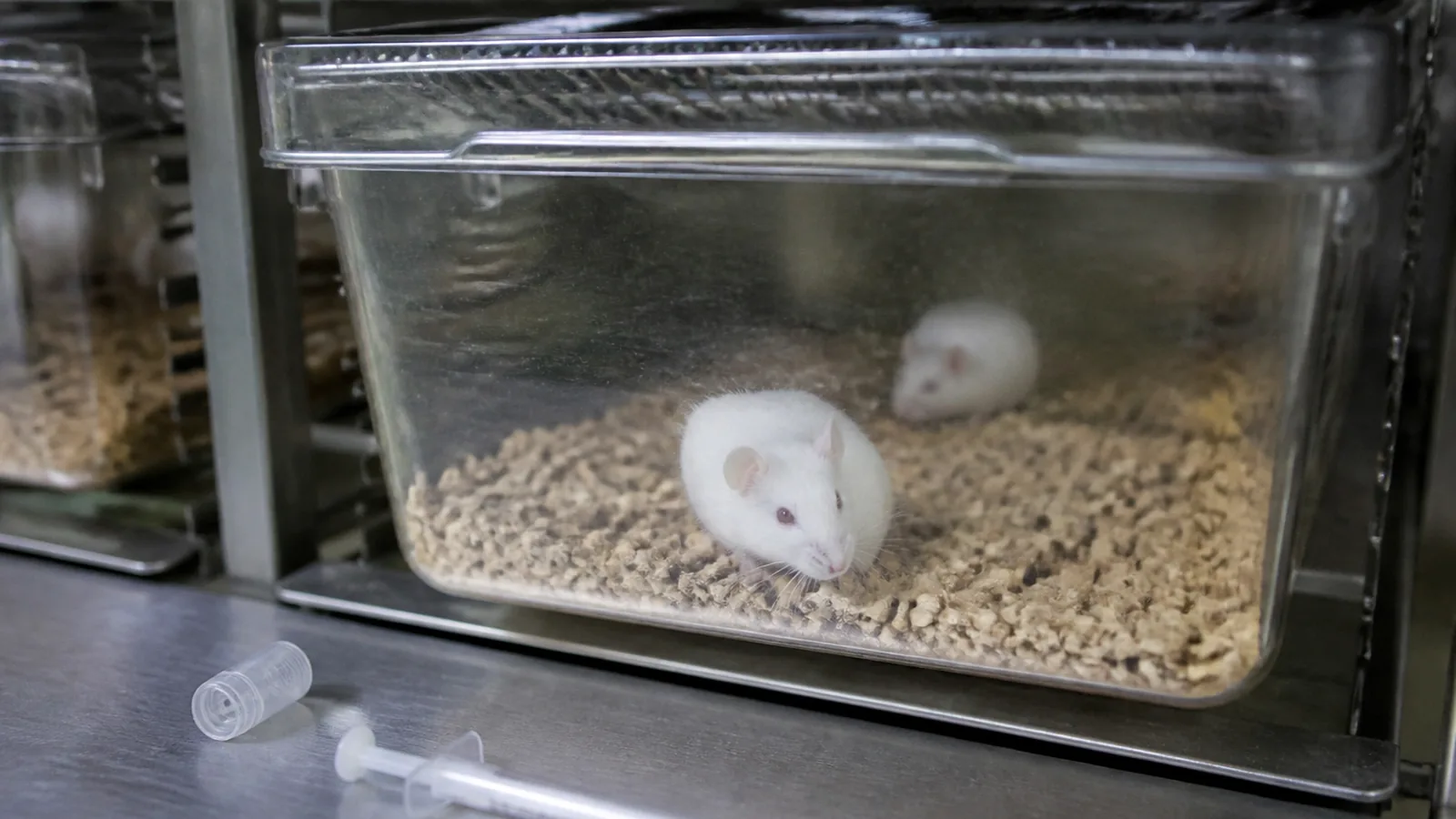
In a lab in Daejeon, a mouse carrying a mutated copy of a gene called Shank3 got a single dose of a synthetic strand of genetic material, and eight weeks later it was grooming itself less compulsively and spending more time near the other mice in the cage. That is the finding at the center of a study published this month in Nature Communications by Eunjoon Kim’s group at South Korea’s Institute for Basic Science, and by the time it reached the health-news aggregators it had picked up a headline it cannot quite support: a new autism therapy, with “surprising benefits even in adult mice.”
Two of those words are doing an enormous amount of work. “Therapy” implies a person. “Adult” implies a patient who missed the developmental window. The study contains neither. What it contains is genuinely interesting science and a familiar problem, and the two are worth keeping apart.
The mechanism is the elegant part. An NMDA receptor, one of the brain’s main excitatory switches, will not fully open on glutamate alone; it also needs glycine sitting in the co-agonist seat. In mice engineered to carry SHANK2 and SHANK3 mutations, two of the better-characterized autism-risk genes, those receptors run cold. Kim’s team went after a glycine transporter, SLC6A20, that normally pulls glycine out of circulation. Knock the transporter down, leave more glycine at the synapse, and the underpowered receptors come back toward normal. They did the knockdown with an antisense oligonucleotide, a short strand of engineered nucleotides that suppresses the gene’s expression, aimed at the cortex and hippocampus so as to spare the brainstem, where the same tinkering would foul up breathing. One administration held for at least eight weeks with no detectable adverse effects. The social deficits and the repetitive self-grooming eased. In CRISPR-edited human cortical organoids carrying the same mutations, receptor function climbed back toward baseline too.
“Unlike gene re-expression strategies, SLC6A20 inhibition works by modulating endogenous signaling pathways and may offer a more practical therapeutic route,” Kim told the press. It is a careful sentence, and to his credit it is hedged. The coverage was not.
Start with who this is for. SHANK3 mutations turn up in an estimated 1 to 2 percent of people with autism and intellectual disability; SHANK2 is rarer still. “Autism” is not one disease with one broken switch. It is a clinical description stretched across hundreds of genetic and environmental routes, and the mouse in Daejeon was built to model one of the narrowest, most monogenic slivers of it. A treatment that rescues NMDA receptor function in a SHANK-mutant animal is a treatment for a specific, uncommon molecular lesion. That is not a small thing. It is just a different thing from the word on the headline.
of autism with intellectual disability
- Lower bound
- 1
- Upper bound
- 2
Then there is the organoid. A cortical organoid is a self-organizing ball of human neurons in a dish, firing in patterns, wired with synapses, and no more a patient than a twitching muscle cell on a slide is a heartbeat. It has no childhood. It has no bloodstream to carry the drug across the blood-brain barrier, and no immune system to turn on a foreign strand of nucleic acid dropped into the brain. Feed it the ASO and the receptors wake up. A human brain is not an organoid.
And this is where the field’s own record earns a hearing. The idea that you can fix autistic behavior by retuning the NMDA receptor is not new, and it has not traveled well. Forest Laboratories spent much of the last decade betting the opposite direction on the same receptor, pushing memantine, an NMDA receptor blocker, through phase 2 trials in hundreds of children. The mouse data had looked encouraging then too. In the pivotal double-blind trial, 67 percent of the children kept on memantine lost their response anyway, against 69 percent of the ones switched to a placebo. Two points apart. The drug went nowhere in autism. A 2025 review of the whole arc landed on the split that memantine kept producing: promising in the lab, conflicting and thin in the clinic. The likeliest reason is the one that shadows every autism drug. “Autism” is not one condition, and a receptor tweak that helps one genetic subset need not touch another. One camp tried to turn the receptor down. Kim’s team is turning it up. Both times, the mouse result arrived dressed as an autism fix.
| Measure | Value |
|---|---|
| Memantine | 67 |
| Placebo | 69 |
The “surprising” adult result deserves the same second look. It is being reported as evidence that the treatable window stays open later than anyone thought. Kim’s own lab, however, showed back in 2019 that correcting NMDA receptor function in adult Shank2 mice already improved their social behavior. The surprise, in other words, was demonstrated by the same group years ago in the same animal. That does not make the new work less careful. It makes the press framing older than it looks.
None of this is a knock on the science, which is exactly the kind of mechanistic work that ought to be funded and read. It is a knock on the distance between what was done and what was announced. A single injection quieted the symptoms of a rare mutation in a mouse and revived a receptor in a dish of human cells. No trial in a human being has been reported, no autistic person has received it, and the last time a drug rode this receptor out of a mouse cage it stalled in front of hundreds of children. The organoids improved. The patients, for now, are hypothetical.
Sources
- ScienceDaily – New autism therapy shows surprising benefits even in adult mice (2026)
- Nature Communications – Roh et al., Slc6a20a-ASO restores NMDA receptor function in SHANK2 and SHANK3-mutant mice and cortical organoids (2026)
- Neuroscience News – Silencing one brain gene may reverse autism deficits, with Kim quotes (2026)
- Drug Target Review – Glycine transporter suppression restores NMDAR function in autism models (2026)
- PMC – Efficacy and safety of memantine in children with ASD: three phase 2 multicenter studies (2019)
- PubMed – Can memantine treat autism? Answers from preclinical and clinical studies (2025)
- ScienceDirect – Early Correction of NMDA Receptor Function Improves Autistic-like Social Behaviors in Adult Shank2 Mice (2019)
- Frontiers in Molecular Neuroscience – Targeting Shank3 deficiency in ASD: a brief review, prevalence and NMDAR mechanism (2023)