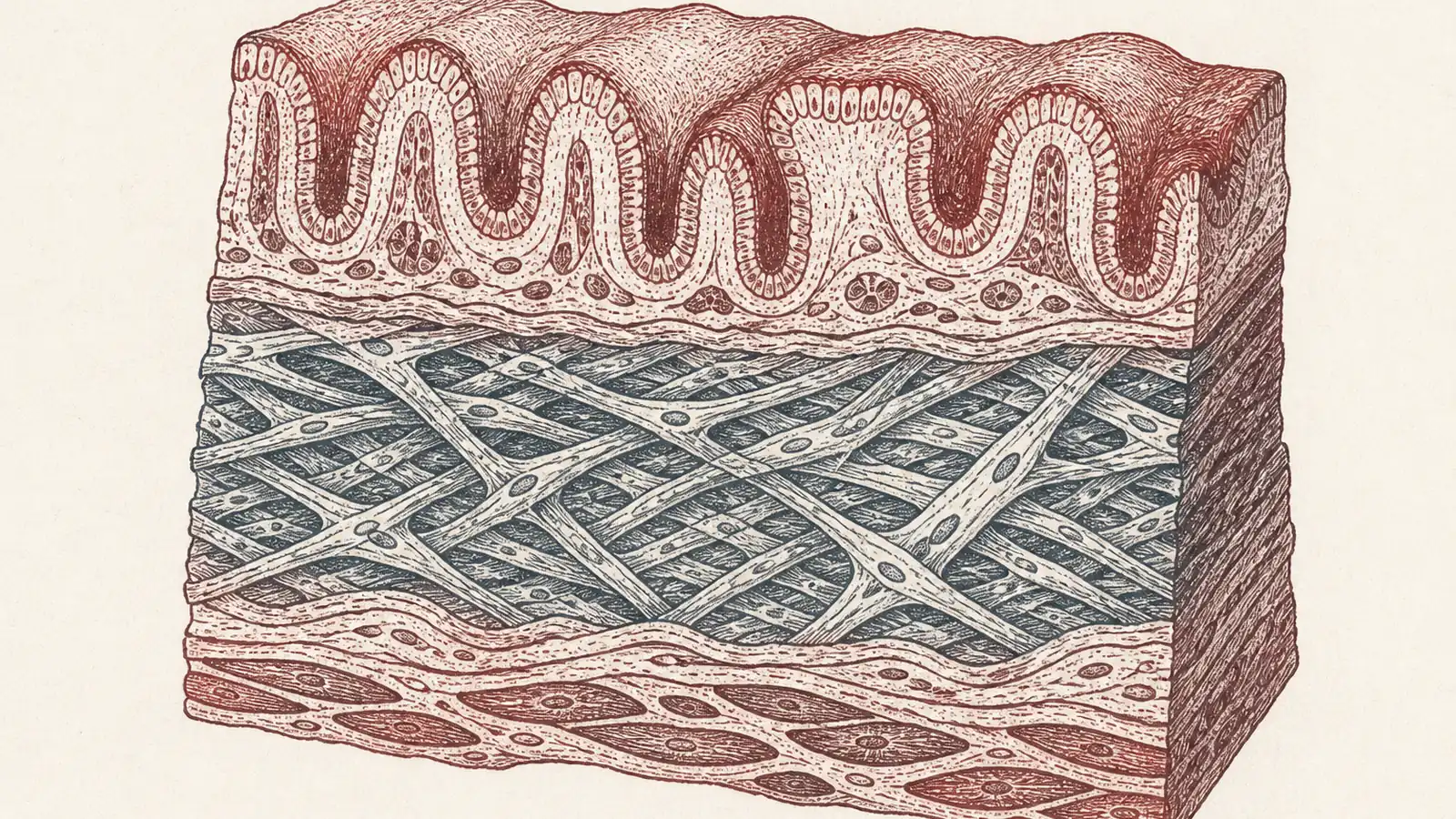
For years I filed Crohn’s disease under one heading in my head: immune system gone feral. It is what every drug label claims, the claim I absorbed without ever checking it. The immune cells attack the gut, so you build a drug that muzzles the immune cells, and for 25 years that is exactly what Crohn’s medicine has done. It works for a lot of people. It also leaves somewhere between a quarter and nearly half of patients cycling through biologic after biologic, and a new atlas of the inflamed gut says that may not be because the drugs are too weak. It may be because they were aimed at the wrong cell.
On August 12, a team publishing in Nature Immunology laid down a multiomic single-cell and spatial atlas of Crohn’s disease, mapping cell by cell and location by location the events inside inflamed tissue. The turn in their finding is not that immune cells stop mattering. It is that the stroma, the structural cells of the gut wall, are active organizers of the inflammation rather than the backdrop it plays out against. Those cells get their internal settings rewired into pathological states, then arrange themselves into self-sustaining “niches,” and the immune cells operate inside a crosstalk the stroma helps direct.
I had stroma filed just as wrong. I thought of it as packing material, the passive mesh the interesting cells sit inside. It is not passive. Intestinal mesenchymal stromal cells build the physical scaffolding of the gut lining and actively shape the tissue niches that tell nearby cells how to behave, which molecules to pour in, which signals to answer. Less the beams of the building, more the electricians and the thermostat. And in Crohn’s, the thermostat gets jammed.
What jams it is the word in the paper’s title, and it is the word that stopped me: epigenetic. The stromal cells are not mutating. Their DNA is fine. What changes is which stretches of it sit open and readable and which stay clamped shut, the chromatin-level switches that decide what a cell becomes. In Crohn’s, per this atlas, those switches get flipped into a pro-inflammatory configuration and stay flipped. So wait, why would that change how you treat it? Because the bad behavior is written into the cell’s operating settings, not just its reaction to the moment. You can shut off the inflammatory signal in the room and the stromal cell keeps running the program from memory.
That is exactly where the drugs have been failing, and now the failure has a mechanism. Anti-TNF biologics, the workhorses of Crohn’s care since the late 1990s, muzzle one specific inflammatory messenger: tumor necrosis factor. They help a lot of people. But somewhere between 23 and 46 percent of patients never respond or lose response, and a longitudinal single-cell atlas of the drug adalimumab, built from nearly a million cells across 216 gut samples from 41 patients, found the tell sitting right there in the stroma. Activated fibroblasts stay stubbornly high in the patients who do not reach remission and fall away in the ones who do. And those fibroblast programs run on signals anti-TNF never touches: IL-11, IL-1, oncostatin M. IL-11-expressing fibroblasts in particular turn up enriched precisely in the nonresponders. You can block TNF all day. The scaffolding keeps the fire lit on a different fuel line.
of IBD patients
- Lower bound
- 23
- Upper bound
- 46
So look at what the last quarter century of Crohn’s medicine has actually done. It bet, enormously and profitably, that the immune cell was the target. Anti-TNF biologics became a multibillion-dollar franchise. And roughly four in ten patients were left with a disease the drug could not reach, told, in effect, that the medicine simply was not strong enough for them. The atlas offers a less flattering reading: for a big share of those patients, the medicine may have been pointed at the wrong cell from the start. And the stroma was not hiding. The foundational maps of these pathological fibroblasts, including a cross-tissue atlas that found the same rogue fibroblast phenotype recurring across four separate chronic inflammatory diseases, were built with funding from AbbVie, Pfizer, Janssen, AstraZeneca, GlaxoSmithKline, Roche and much of the rest of the biologics field. The cell type that may explain their drugs’ failure has been sitting in their own funded data for years.
A map is not a cure, and I want to be honest about the gap. Nobody has handed a Crohn’s patient a drug built to reset a stromal cell’s epigenetic settings and watched the disease let go. IL-11-blocking antibodies are in development, and the hopeful part of an epigenetic lock rather than a genetic one is that a lock can, in principle, be reopened. But what this atlas changes is not the treatment. It is the excuse. The stroma is not a bystander in Crohn’s, and treating it like one is now a choice someone is making.
If I were the patient watching a second biologic quietly stop working, here is the conversation I would force before a third. I would ask my doctor to say plainly whether my nonresponse is being read as “the drug is not strong enough” or as “the drug does not reach the cell driving this in my gut,” and I would put the IL-11 and stromal question on the table myself instead of waiting for a treatment guideline to catch up to an atlas that is already published. I do not have Crohn’s, so I get to hold this at arm’s length, which feels almost unfair to say. But I would rather ask the awkward question five years early than accept, one more time, that the fault was mine for failing to answer a drug that was never built to reach the cell holding my disease in place.
Sources
- Nature Immunology – Epigenetic modulation of stromal cell states underpins pathological tissue niches in Crohn’s disease (12 Aug 2026)
- JCI Insight – IL11+ fibroblasts implicated in nonresponse to anti-TNF-α in IBD (nonresponse in 23–46% of patients)
- PMC – A longitudinal single-cell atlas of anti-TNF (adalimumab) treatment in IBD (~1 million cells, 216 samples, 41 subjects; activated fibroblasts predict nonremission)
- Med (Cell Press) – Cross-tissue single-cell stromal atlas: shared pathological fibroblast phenotypes across four chronic inflammatory diseases
- International Journal of Molecular Sciences – Tissue niches formed by intestinal mesenchymal stromal cells in mucosal homeostasis and immunity