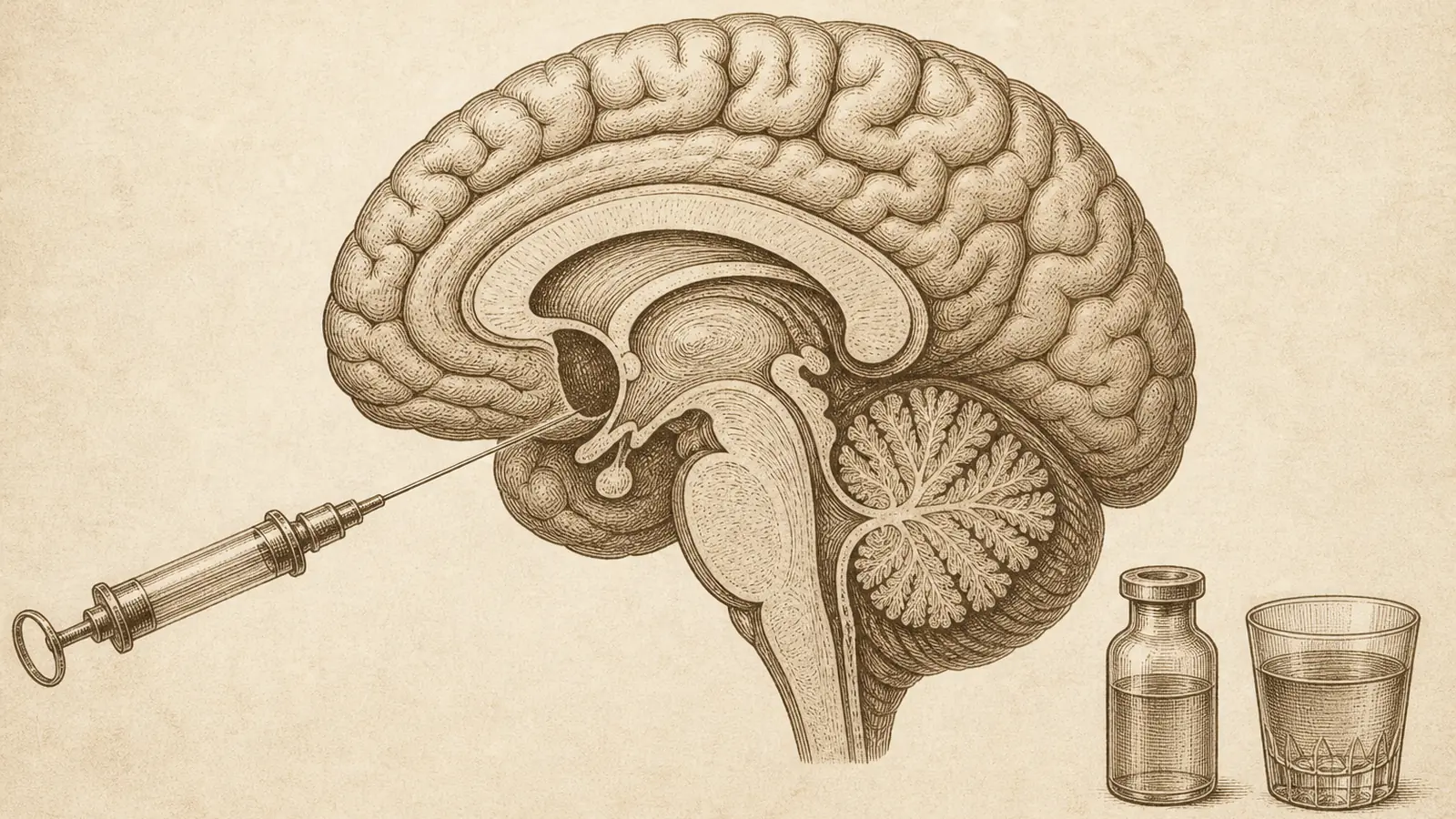
My mistake was assuming a drug that kills a craving has to work where the wanting lives, somewhere deep in the reward machinery, dialing down the pleasure until the pull goes quiet. That turns out to be backward, and what the brain is actually doing is stranger and more useful.
Here is what sent scientists looking. People taking Ozempic to manage their blood sugar kept mentioning, almost in passing, that they also wanted to drink less. Then came the popularized version, pushed into the feed this month by University of Otago neuroscientist Robert Munn: semaglutide, the molecule inside Ozempic, loosens the grip of alcohol, and maybe nicotine and the rest of the catalogue people reach for compulsively. The evidence underneath that headline is narrower than the headline, mostly alcohol, with a smaller signal for cigarettes. But when researchers went hunting for where in the brain the effect lives, they did not land in the nucleus accumbens, the dopamine hub every reward map circles in red. They landed somewhere quieter: the lateral septum. And nobody selling the shot is paying for that discovery, which is a thread worth pulling later.
So I had to go learn what the lateral septum even does, because it is not a region most of us were taught to care about. It sits along the midline, it is packed with GLP-1 receptors, and its work is less “feel good” than “connect the dots”: it ties a memory and a place and a mood to a reward, the associative glue that turns a bar, a smell, a Friday night into a want. And it does a lot of that through inhibition. Functionally, the lateral septum is a brake.
So why would a blood-sugar drug be pressing a brake in a memory-linking node instead of turning down pleasure directly? That is the question that got me, and the mechanism work has an answer that is almost elegant. In a rodent study from Elisabet Jerlhag’s lab at the University of Gothenburg, activating GLP-1 receptors in the lateral septum with the agonist exendin-4 ramped up inhibitory, GABA-based signaling, and that inhibition reached forward and quieted the dopamine that alcohol normally pours into the nucleus accumbens. The reward did not get blocked at the reward center. It got dampened one step upstream, by a region telling the accumbens to settle down.
The receipts are specific, and they run both directions. Exendin-4 dropped voluntary alcohol intake by 28.7 percent in male rats and 35.3 percent in females over 24 hours, and the animals stopped forming a strong preference for the place where they had been getting alcohol. Then the same team blocked those septal receptors with an antagonist, and alcohol intake climbed. Take your foot off the brake and the animal drinks more. That two-way result is what convinces me the septum is doing the work here and not just riding along.
| Measure | Value |
|---|---|
| Male rats | 28.7 |
| Female rats | 35.3 |
A second team, publishing in Neuron, came at it from the drug side and found the same wiring. Liraglutide, an older GLP-1 agonist, cut alcohol intake and blunted the alcohol-triggered dopamine spike in the accumbens, and it needed the lateral septum’s GLP-1 neurons to pull it off. Silence those neurons and the drug stopped working. Switch them on with chemogenetics and the animals eased off alcohol on their own. Two labs, two methods, one small region behaving like the “enough” signal the brain apparently keeps on staff.
Now the part where I put a brake on myself, because this is exactly where the excitement outruns the evidence. Almost everything above is rodents. The human record is two trials, both small. The first, a phase-2 trial led by Christian Hendershot in JAMA Psychiatry, gave low-dose semaglutide to 48 adults with alcohol use disorder for nine weeks; craving fell, drinks per drinking day fell, heavy-drinking days fell against placebo, and among the smokers, cigarettes per day dropped too, per the UNC team that ran it on an NIAAA grant. The second, a 2026 Lancet trial in 108 people who had both alcohol use disorder and obesity, ran 26 weeks on the higher 2.4-milligram dose alongside talk therapy and cut heavy-drinking days by 41.1 percentage points, 13.7 points more than the placebo group got from therapy alone (p=0.0015). By number needed to treat, semaglutide came out at 4.3, better than the 7 or higher typical of the drugs already approved for alcohol use disorder. The brain story is enormous. The human evidence is 156 people across two rooms.
And now pull that thread. Ozempic is FDA-approved for type 2 diabetes and to cut cardiovascular risk in diabetics, full stop. Its label says nothing about cravings, alcohol, nicotine, or addiction, because Novo Nordisk has not run the trials to earn those words. The addiction science is being done by university labs on public money, the NIAAA’s R21 grant and its like, while the company sells a diabetes drug into a demand it never had to fund. Meanwhile people are self-prescribing off the headlines, and the FDA’s own adverse-event file logs Ozempic reports flagged off-label use next to impaired gastric emptying, the stomach slowing to a crawl, an effect the drug’s own label already describes. A brake in the septum does not cancel a brake in the stomach.
I find the biology thrilling, and I am not going to pretend otherwise: the idea that compulsion has a physical off-ramp, that the brain runs an inhibitory circuit we might learn to support, reframes addiction as something with a mechanism instead of a moral failing. So starting now, I will stop believing self-control lives in the reward center, and start paying attention to the brake. What I will not do is put a diabetes shot in my arm to quiet a craving on the strength of a cage of mice and 156 people over a couple of months, from a company that profits before it proves anything.
Sources
- ScienceDaily / The Conversation – Robert Munn, “Ozempic may have revealed the brain’s hidden craving center” (2026)
- PMC / eBioMedicine – Edvardsson, Cadeddu, Ericson, Adermark, Jerlhag, an inhibitory GLP-1 circuit in the lateral septum modulates reward processing and alcohol intake in rodents (University of Gothenburg, 2025)
- Neuron (Cell Press) – a septal inhibitory circuit constrains alcohol reward and mediates liraglutide’s suppressive effects on alcohol intake in mice (2026)
- JAMA Psychiatry – Hendershot et al., once-weekly semaglutide in adults with alcohol use disorder, randomized trial (2025)
- The Lancet – once-weekly 2.4 mg semaglutide vs placebo in alcohol use disorder with comorbid obesity, randomized trial (2026)
- UNC Health Newsroom – semaglutide reduces cravings and heavy drinking; NIAAA grant R21AA026931; Hendershot and Klein (2025)
- FDA – Ozempic approval overview, NDA 213051 (Novo Nordisk)
- FDA – Ozempic prescribing label, NDA 213051 (2025)
- FDA FAERS – Ozempic adverse-event report: off-label use with impaired gastric emptying (2026)
- FDA FAERS – Ozempic adverse-event report: impaired gastric emptying (2026)