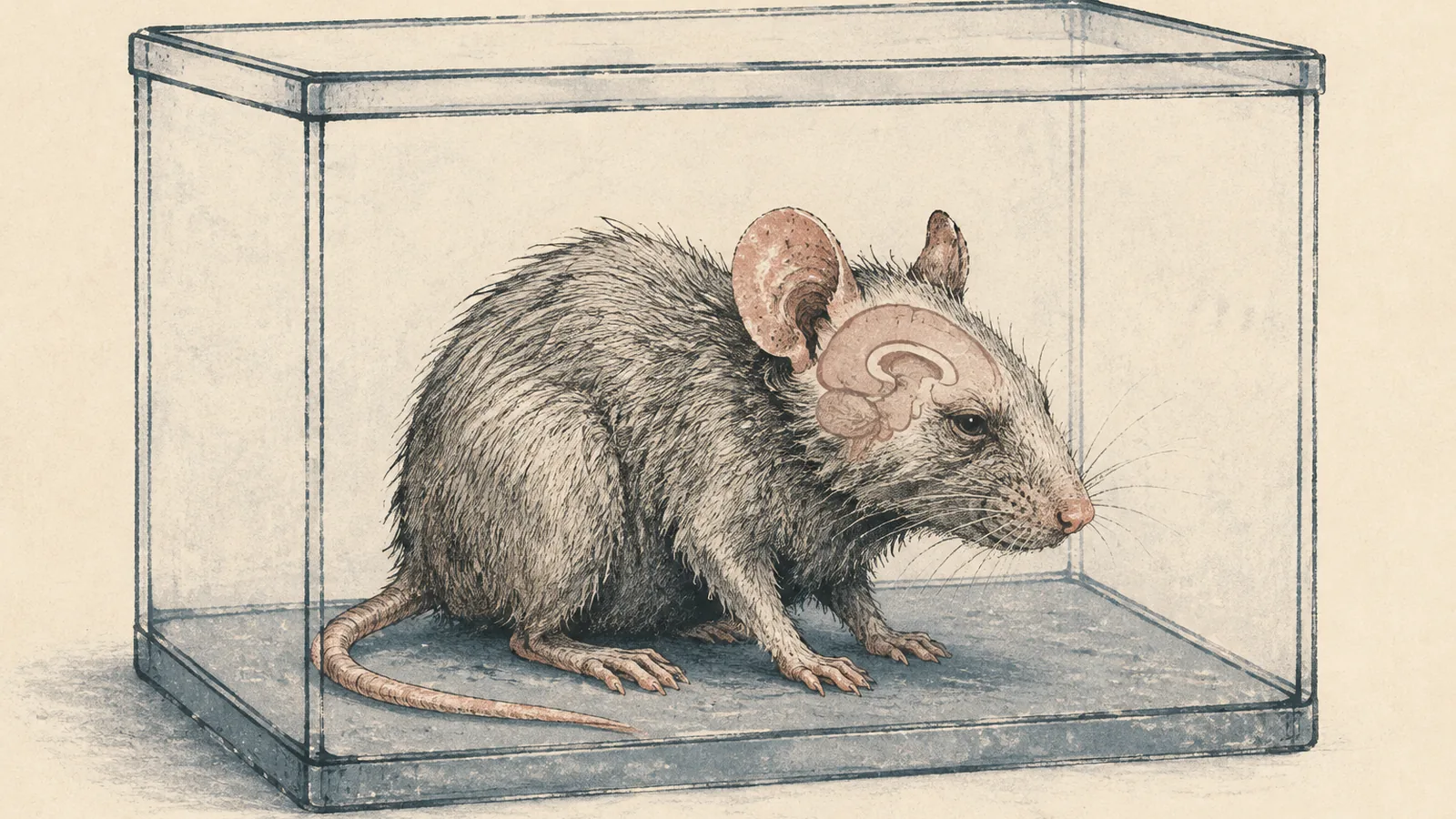
“We’ve been trying to figure out why we age,” Katrin Andreasson, the Stanford neurologist who ran the study, told her own university’s news office. “Now we know at least one big reason for it.” It is the kind of line that has launched a thousand press releases, and anyone who has read a few thousand of them learns to hold it at arm’s length until the fine print arrives. The fine print, in this case, is that the sentence is about mice.
The finding itself is elegant, and worth understanding before the caveats crowd in. Andreasson’s lab, publishing in Science on July 16 and pushed back into the news cycle by a ScienceDaily writeup in September, has been chasing a single molecular handshake. A prostaglandin called PGE2 rises with age. It docks onto a receptor, EP2, that sits on tissue-resident macrophages, the cells Andreasson calls “the body’s garbage collection crew.” When too much PGE2 hits too many EP2 receptors, the crew stops doing its job. The job it stops doing is clearing out senescent neutrophils, the burned-out remains of the immune system’s most disposable soldiers, which the body churns through at roughly 100 billion a day. The garbage piles up, and the garbage is inflammatory. Chronic inflammation is what quietly corrodes an aging body from the inside.
So the team deleted EP2 from the macrophages of mice, and then watched what a life without that particular signal looked like.
What it looked like was startling. Old mice, the 23-to-25-month range that in mouse terms is deep retirement, held onto the bodies of much younger animals. Of 71 blood proteins that normally drift with age, 59 stayed at youthful levels. The engineered mice carried less visceral fat and more muscle. They ran mazes and recognized objects nearly as well as six-month-olds. Their grip was stronger, their balance steadier, and the inflammation that usually smolders through the blood, liver, colon, heart, kidney, and hippocampus had cooled across the board. On paper it reads less like slowing aging than like refusing to schedule it.
That is what the headline sells.
The mice got younger. The humans in the study were never touched. The “human” side of this work is a database of human liver cells, young, old, and diseased, in which the researchers found the same cascade the mice showed them: neutrophils accumulating, senescence rising, the macrophage cleanup crew thinning out, EP2 activity climbing. That is a real and useful correlation, and Stanford’s news office calls it a first-time observation in human cells. It is also exactly what it is, a snapshot of aged tissue that matches the mouse story, not a person who was given anything and got better. No one in this study was treated. The distance between “we found the switch in a mouse and in a database of old livers” and “we know why you age” is the distance the word “now” is doing a great deal of work to cover.
Then there is the drug, which does not exist. No EP2-selective inhibitor is approved for anything, which is why Andreasson’s own language turns from triumph to to-do list. The team ran an experimental compound into 22-month-old mice for two months and reported that neutrophil levels edged back toward youthful ranges, a proof of concept rather than a therapy. She is candid about the gap in a way the amplifying coverage is not. “We need to develop a safe drug,” she said, one that shuts down EP2 “without disrupting upstream events such as PGE2 production.” PGE2 signaling is not a spare part. It runs pain, fever, and normal immune defense. Blocking it body-wide, for years, in humans who are not mice, is the entire unsolved problem, and human testing has not begun.
None of this is new territory for the lab, which is its own kind of reassurance and its own kind of warning. Andreasson has been on the EP2 trail for years; a 2021 paper in Nature reported that blocking the same signal restored youthful metabolism to immune cells and reversed cognitive decline in aging mice. The new work extends the brain story to the whole body. It also lands in a field littered with mouse triumphs that thin out in translation. Senolytics are the cautionary tale longevity researchers recite from memory: senescent cells cleared, mice rejuvenated, human trials that have yet to hand anyone a second youth. A mechanism that works in a genetically engineered animal is a hypothesis about people, not a finding about them.
Follow the money and the picture sharpens rather than dims. The work was underwritten by the NIH, the American Heart Association, and Stanford, alongside two outfits built with Silicon Valley fortunes, the Arc Institute and the Chan-Zuckerberg Biohub, plus the Phil and Penny Knight Initiative for Brain Resilience, named for Nike’s founder. That funding does not make the science wrong. It does mark which race this result is running in. And there is a detail the press materials do not lead with: Andreasson and two co-inventors have filed patents on blocking myeloid EP2 signaling to restore youthful metabolism and quiet age-related inflammation, which is to say on doing the exact thing this paper says would slow aging. The scientist who found the switch also holds a claim on flipping it.
That is not a scandal. It is how translational science works, and disclosing it plainly would be the ordinary courtesy. But it is the reason to read “now we know one big reason we age” as the opening bid in a drug-development campaign, not a closing statement about the human condition. The mice held their grip strength and finished the mazes; that much happened. Somewhere in a Stanford dataset sits the profile of an old human liver that agrees with them. Everything between that dataset and a pill you could swallow is still, for now, a very good story about a mouse.
Sources
- Science: Tan, Conley, Andreasson et al., “Restored clearance of senescent neutrophils by tissue-resident macrophages limits organ aging” (2026)
- Stanford Medicine News: “Breakdown of immune cells’ interaction is key driver in aging, study finds” (2026)
- ScienceDaily: “One immune switch may help drive aging across the body” (2026)
- Nature: Minhas et al., “Restoring metabolism of myeloid cells reverses cognitive decline in ageing” (2021)
- Justia Patents: Katrin Andreasson, inventor record