I have a reflex I’m not proud of. The second a headline tells me a berry “burns fat,” some tired part of me starts drafting the eye-roll before I’ve read a word, because I’ve watched too many antioxidants get marched from a culture plate to a supplement label with nothing in between. So when I saw that a compound in blueberries was helping muscle cells torch their own fat, I braced. Then I read what the Japanese team actually did, and the reflex embarrassed me, because the compound didn’t do the thing I assumed it did. It didn’t turn the fat-burning switch on. It stopped the cell from throwing the switch away.
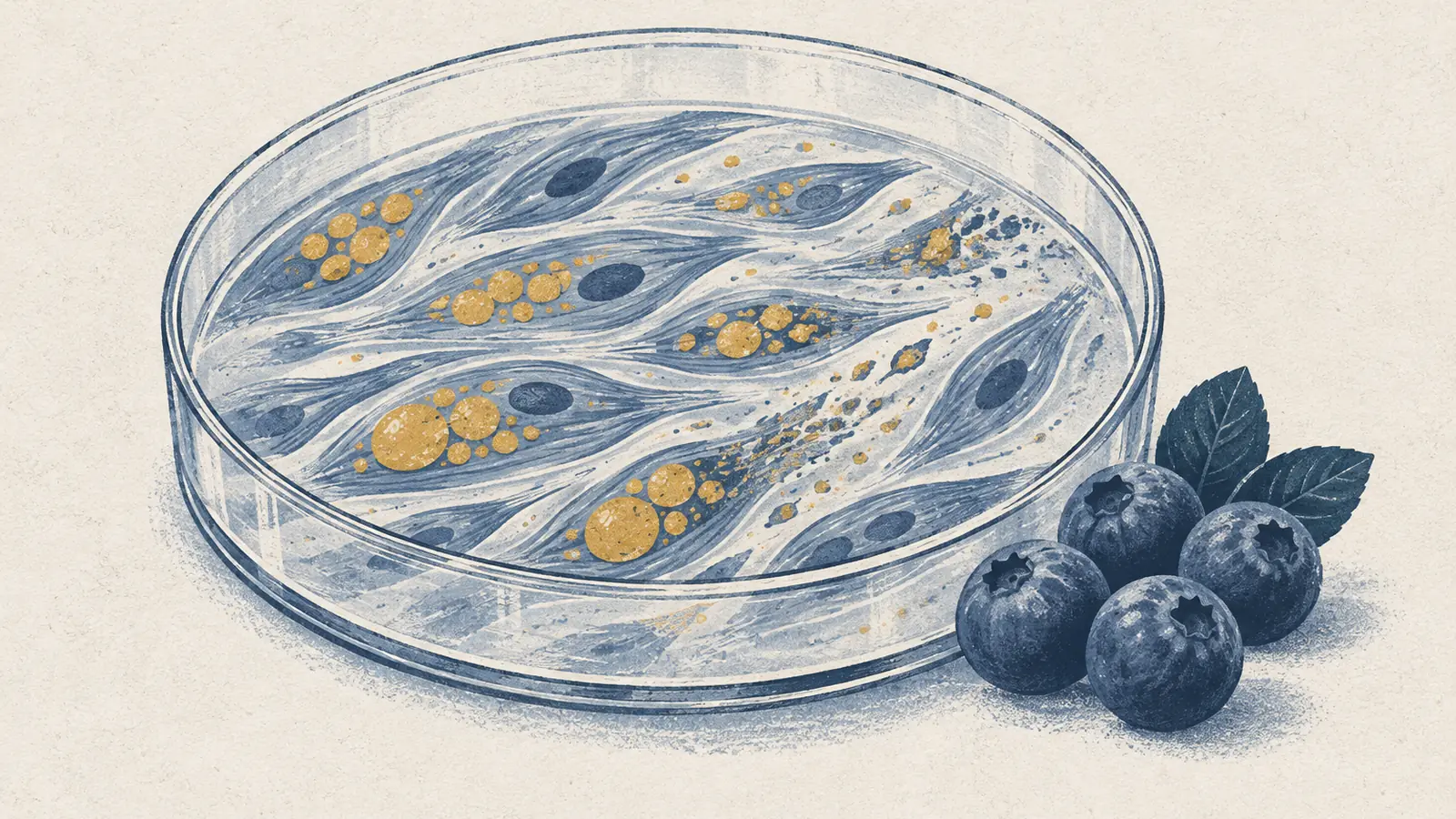
Here’s the plain event. A group at Shinshu University, led by Associate Professor Takakazu Mitani, screened a panel of food-derived compounds to see which could pull excess fat out of skeletal muscle cells. Pterostilbene won, a polyphenol cousin of resveratrol found in blueberries and grapes. In cultured C2C12 mouse muscle cells it produced the strongest drop in stored lipid of anything tested, and the work landed in the journal Food Bioscience in September. I want to be straight with you before we go one sentence further: this is cells in a dish, not you eating a bowl of blueberries.
So how does it work? I assumed the obvious way, that pterostilbene flips on the master switch for fat-burning, a nuclear receptor called PPARδ. That’s how most of these molecules earn their headline: they bind the switch, the switch turns on. But pterostilbene doesn’t touch the switch. Wait, so how does it turn anything on? It doesn’t. It stops the cell from destroying the switch it already has.
Every protein in your cells has a shelf life. When one is worn out, the cell tags it and feeds it into the ubiquitin–proteasome pathway, the cell’s shredder, which grinds spent proteins back into parts. Pterostilbene jams the shredder for this one protein. PPARδ stops getting fed in, so it piles up inside the cell, still intact, still telling the machinery to break down fat. The researchers call it a non-canonical mechanism, the polite academic way of saying “not how we expected.” I honestly love it. The compound didn’t push the switch harder. It stopped the cell from shredding the switch.
And you can watch the consequences. The treated cells started releasing glycerol, the backbone left over when stored fat gets pried apart, spilling it into the surrounding fluid, and they cranked up the genes for fatty-acid oxidation, the actual burning step. More regulator in the cell, louder fat-burning genes, droplets coming apart. The logic clicks together so cleanly that I want to slow it down, because clean logic in a dish is exactly the kind of thing that gets oversold.
The target is a genuine problem, which is what makes the hype dangerous. The condition the team is aiming at is myosteatosis, fat that infiltrates the muscle itself, the marbling you’d want in a steak and absolutely do not want in your thigh. It tracks with insulin resistance, type 2 diabetes, and the slow metabolic decline of aging, and the researchers are blunt that no approved drug targets it. A food-derived compound that coaxes muscle to clear its own fat is an appealing idea, which is exactly why the jump from a mouse-cell plate to your dinner plate is where I plant my feet.
Two things stand between this study and your kitchen. The first is dose. The pterostilbene in an actual blueberry is a trace; the amounts that have done anything measurable in people come from concentrated supplements, not fruit. The largest human safety trial, Riche and colleagues in 2013, ran 80 adults on up to 250 milligrams a day for about seven weeks and found no harm to liver, kidney, or glucose markers, with mostly a bump in appetite. Safe, though, is not the same as proven to do anything for muscle fat.
The second is that the supplement industry already knows pterostilbene beats resveratrol, because it’s far more bioavailable. Two methoxy groups make it more fat-loving and easier to absorb, giving it around 95 percent oral bioavailability against resveratrol’s 20 percent, and it lingers in the blood for 105 minutes to resveratrol’s 14. This is a molecule built to sell, and a shiny mechanism paper is rocket fuel for the marketing.
So here’s what the study can’t tell you yet. No animal ate pterostilbene and lost muscle fat in this work, and no human did either, and the university’s own announcement names no funder, which I went and checked, because a mechanism paper this marketable is exactly the kind where you want to know who paid for it. The open question isn’t whether the mechanism holds up; in a dish, it clearly does. It’s whether a dose you could safely swallow does inside a living body what it did to a plate of cells, where blood flow, other organs, and your own metabolism all get a vote.
I came in ready to roll my eyes, and I’m leaving charmed by the mechanism and completely unmoved on the supplement. I’m not buying a bottle of pterostilbene off the strength of a petri dish. I’ll keep eating the blueberries, for the fiber and the polyphenols and the plain fact that I like them, and I’ll wait for the study that puts this compound in an actual body and sees whether the switch stays out of the shredder.
Sources
- Shinshu University – “Pterostilbene Modulates Skeletal Muscle Lipid Metabolism Through PPARδ Stabilization” (Sept 2026)
- ScienceDaily – Compound in blueberries may help muscle cells burn excess fat (Sept 2026)
- MedicalXpress – Berry compound reduces fat buildup in muscle cells, study finds (Sept 2026)
- PMC – Riche et al., Analysis of Safety from a Human Clinical Trial with Pterostilbene (2013)
- Journal of Applied Pharmaceutical Science – Resveratrol and pterostilbene: a comparative overview (chemistry, bioavailability, pharmacology)