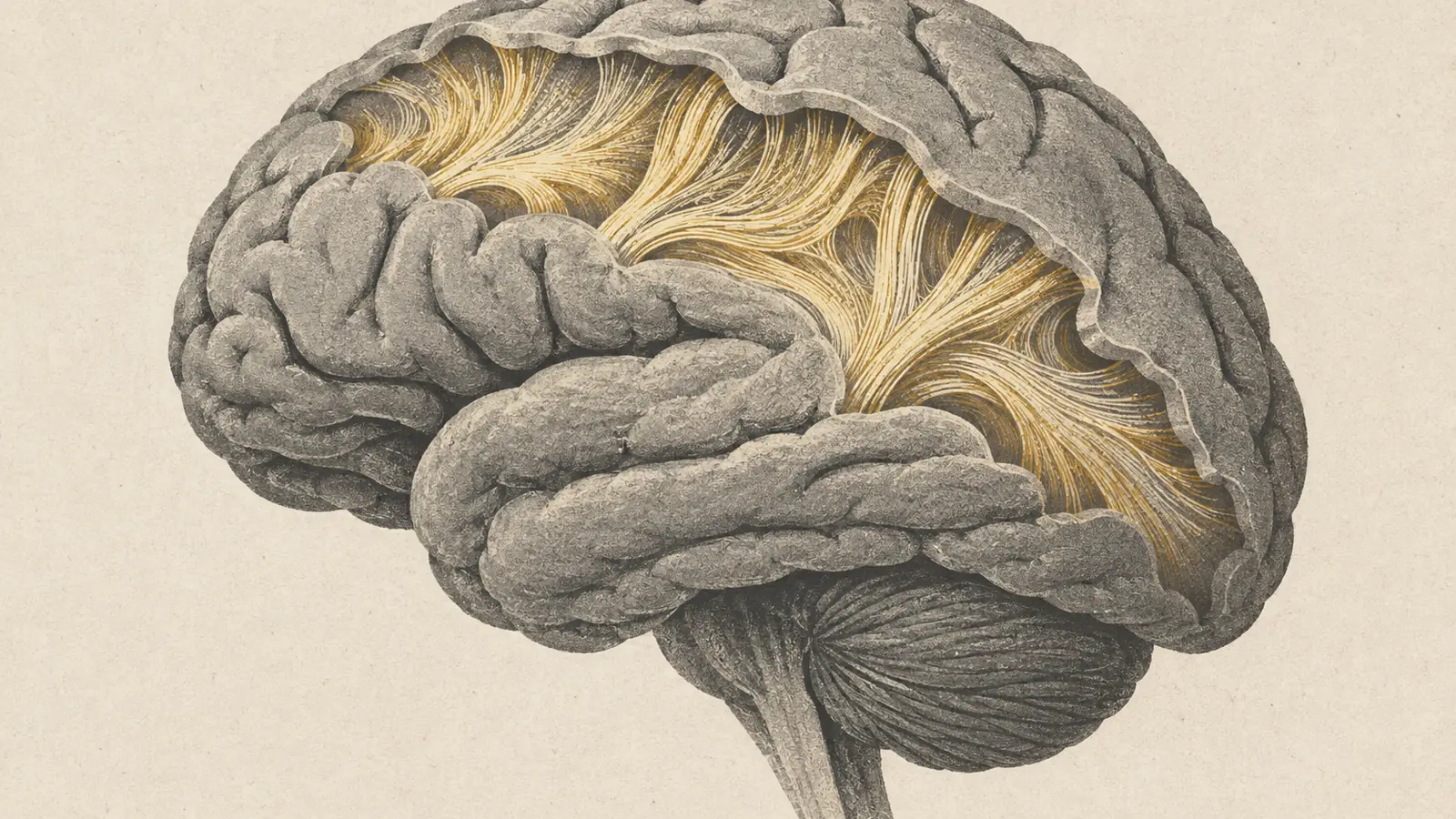
For most of my adult life I filed brain health under one heading: protect the gray matter, the thinking part, and you protect the mind. Do the puzzles, learn the language, guard the neurons. So a study out of USC this week made me put my coffee down. The tissue that best predicted whether these aging brains stayed sharp was not the gray matter at all. It was the wiring tucked just underneath it.
The work appeared in Alzheimer’s & Dementia, the journal of the Alzheimer’s Association, out of the Stevens Neuroimaging and Informatics Institute at USC’s Keck School of Medicine. First author Yingxu Liu and senior author Leon Aksman put 459 adults aged 60 and older through advanced diffusion MRI and a full battery of cognitive tests. What makes this cohort unusual is who was in it: community-dwelling older people from across India, part of the LASI-DAD aging study, where more than 50 percent had low literacy and about 60 percent lived in rural areas. That is close to the mirror image of the educated, urban, mostly Western brains that most of what we “know” about aging is built on.
Here is where I had to slow down. When you picture white matter, you probably picture the long-haul tracts, the highways carrying signals across the brain. This study is not about those. It is about the superficial white matter, a thin band of short, curved fibers sitting maybe 6 millimeters below the surface of the cortex, connecting one fold of the brain to the fold right next door. Neuroscientists call them U-fibers. Think of them as local roads. They rarely get a second look when the worry is dementia; the attention goes to the gray matter and the big tracts.
Using diffusion MRI, the team measured something satisfyingly physical about those local roads. In this imaging model, healthier-looking wiring meant higher neurite density, how tightly the little fibers are packed, and less free water pooling in the spaces around them. Wait, why would the dampness of a strip of tissue barely under the surface predict whether an 80-year-old can still find her words? Because the gray matter can only work with the signal it receives. Liu put the division of labor plainly: gray matter processes the information, and the superficial white matter helps neighboring regions talk to each other. If the local roads are degraded, the message never arrives cleanly, no matter how much processing power survives.
The finding that flipped my assumption: two people can lose the same amount of gray matter and land in very different places. When the superficial white matter was healthier, the link between gray matter loss and weaker cognition got softer. The gray matter was still shrinking. It just cost less. Aksman called the wiring “a possible source of resilience.” The strongest, most consistent thread ran through language, through the frontotemporal regions that handle recognizing words, speaking fluently, and holding a phrase in mind long enough to use it.
Then the detail I keep turning over. The protective link between healthy wiring and sharp language was most pronounced in the participants with no formal education, low literacy, or rural residence. That quietly pokes a hole in the tidy story we have all been sold, that schooling builds “cognitive reserve” and reserve is what saves your mind. In the people with the least of that supposed reserve, the wiring itself seemed to be doing the heavy lifting. Reserve may never have been only a matter of years in a classroom. Some of it looks physically built into the tissue.
I am not going to oversell you a scan. This is one snapshot in time, a single MRI and one testing session for each of the 459 people, and a correlation cannot tell you which way the arrow points. Did healthy wiring protect cognition, or do sharper brains simply keep their U-fibers in better shape? The researchers say it themselves: long-term studies are needed to know whether preserving these connections preserves the mind. What they have drawn is a map of where resilience lives, not a set of directions for building it. Nobody has shown you can protect these little roads on purpose. That trial does not exist yet.
What I do trust is where this came from. Arthur Toga, who directs the institute, made the point that understanding brain aging “requires research that reflects the world’s social, cultural, and geographic diversity.” He is right, and it is a little damning that this still needs saying out loud in 2026. The brains carrying the clearest signal here are exactly the ones the field usually leaves out.
So what do I do with it? I stop treating my gray matter as the whole game. The connective tissue between the neurons, the plumbing, deserves at least as much of my attention. The ordinary things already known to protect small vessels and white matter, moving most days, sleeping, keeping blood pressure off the ceiling, are broader brain-health priors and not findings from this study, but they point the same unglamorous direction and cost me nothing to start. I am not waiting for the U-fiber supplement to arrive, and it will, because it always does. I would bet on the wiring, and I would start now.
Sources
- Keck School of Medicine of USC – “USC study finds gray and white matter work together to support cognition in older adults”
- ScienceDaily – “Hidden brain wiring may help keep the mind sharp as gray matter shrinks”
- Liu Y., Aksman L., et al., Alzheimer’s & Dementia: The Journal of the Alzheimer’s Association (published August 20, 2026) – superficial white matter, cognitive resilience, and gray matter atrophy in the LASI-DAD cohort.