For years I filed pomegranate in the same mental drawer as açaí and wheatgrass: pleasant, expensive, wearing a health halo three sizes too big for the actual evidence. Antioxidant this, polyphenol that. So when a study crossed my desk claiming a pomegranate compound improved heart function by as much as 80 percent, my first instinct was a slow, practiced eye-roll.
Then I read who did it, and what they were actually treating, and the eye-roll stalled halfway.
The work comes from Joseph Burgoyne’s lab at King’s College London, published September 28 in Science Advances and funded by the British Heart Foundation. The target is heart failure with preserved ejection fraction, HFpEF, the version of heart failure that quietly humiliates cardiology. In HFpEF the heart still squeezes fine. It just can’t relax. The muscle grows stiff, refuses to fill properly between beats, scars over, and thickens, and for decades doctors have had almost nothing that reverses that stiffening. Roughly half of all heart-failure patients have this kind, and until the SGLT2 inhibitors showed up recently, the drug cabinet was close to empty.
So this is not a “superfood boosts wellness” story. It is a story about a disease with a real treatment vacuum, and a molecule that walked into it.
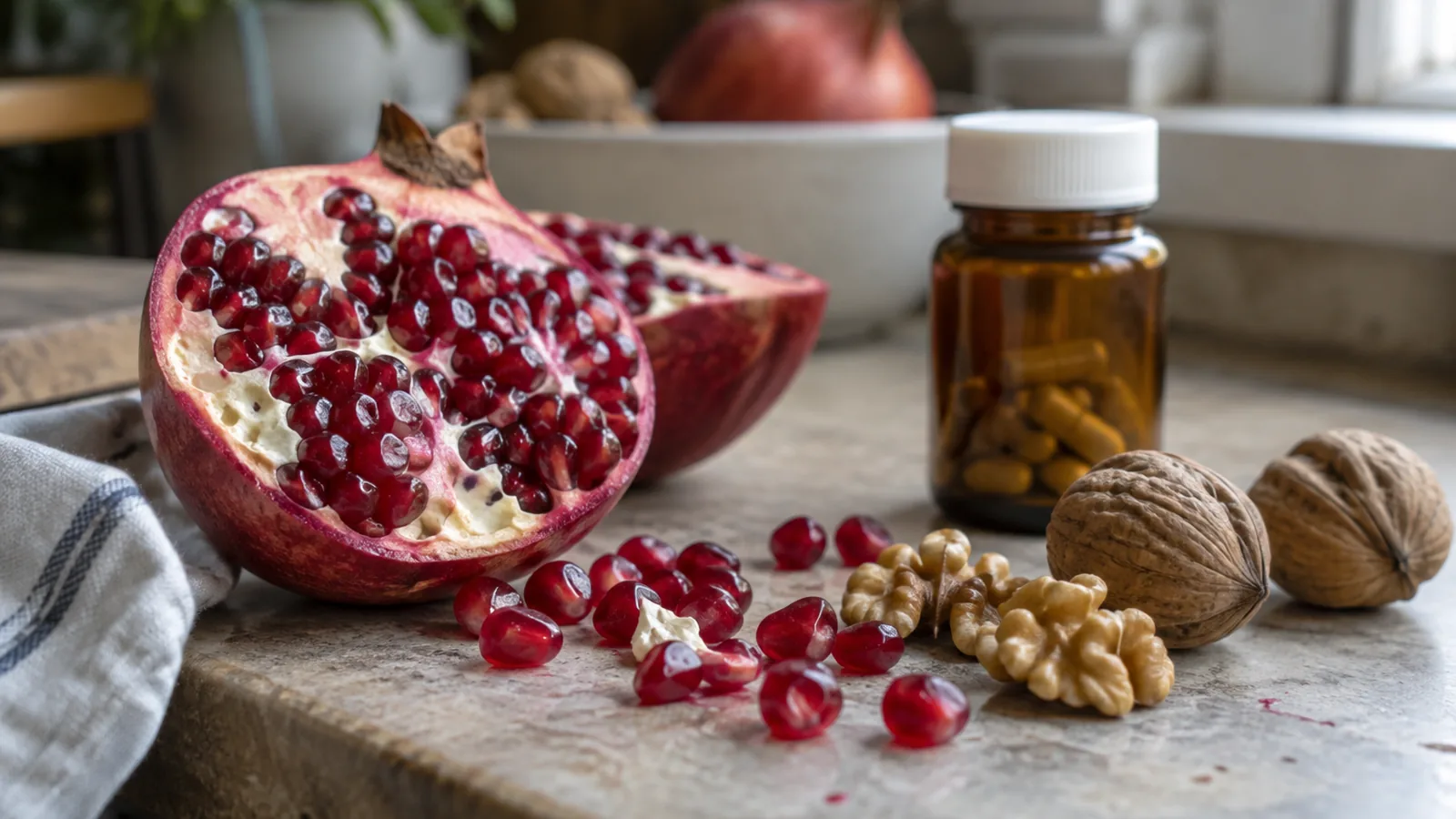
The molecule is urolithin A. You do not get it from eating a pomegranate. Your gut does. When you eat pomegranate, walnuts, or certain berries, you swallow big clumsy polyphenols called ellagitannins that your body can’t really use. Your gut bacteria break them down, step by step, and some of them, at the end of that microbial assembly line, produce urolithin A. The fruit is just the raw material. The molecule that does the work gets built in your colon by bacteria, and pours into circulation from there.
Which raises the obvious question: how does a compound born in your gut end up loosening a stiff heart? That was the question that stopped me skimming. The short version is that urolithin A flips a molecular switch telling heart muscle to relax. The King’s team reports it activates a protein called PKGIα by grabbing onto one specific amino acid on it, and PKGIα is essentially that relaxation switch, the signal that tells cardiac tissue to let go between beats. Flip it on, and in their animals the heart relaxed better, scarred less, and stopped its harmful thickening. They saw the same softening in lab-grown human heart tissue, which is the detail that keeps this from being pure rodent trivia.
I love a clean mechanism, so I went looking for whether anyone else had landed in the same place independently. They had, by a completely different route. A separate group at the Gwangju Institute of Science and Technology in South Korea ran urolithin A through their own HFpEF mouse model and published in Experimental & Molecular Medicine that it improved diastolic function, shrank the hypertrophy, and cut the fibrosis. Their explanation had nothing to do with a relaxation switch. They found urolithin A switching on the AMPK-mTOR pathway to clear out damaged mitochondria, a cellular housekeeping process called mitophagy, and separately reshaping the gut microbiome to lower circulating ceramides, the fatty molecules that poison stressed heart tissue.
Two labs, two continents, two entirely different proposed mechanisms, and the same result in the same disease. When independent groups reach the same finish line by different paths, I trust the finish line more, even when I’m not sure which map is right.
Now the cold water, because you deserve it. Both of these are mouse studies. The “80 percent” figure is a press-release number attached to specific measures of heart function in rodents, not a clinical outcome in a living person.
And nobody has run urolithin A through a real HFpEF trial in people. Engineered heart tissue relaxing in a dish is encouraging, but iPSC-derived heart cells are immature, and the Korean authors said so themselves. The honest status: promising biology, zero human heart-failure evidence.
Here is where my skeptic fully wakes back up. Urolithin A is not some obscure lab reagent you’d wait a decade to access. It is already on shelves. A Swiss company, Amazentis, sells it as Mitopure and under the Timeline brand, and has marketed it for years on the strength of mitochondrial and muscle claims. Their own human trial is the tell: Cell Reports Medicine reported that 500 mg daily over four months produced roughly a 12 percent bump in leg-muscle strength in middle-aged adults. Measurable, and modest. That is muscle, not myocardium, and the gap between “improved my leg press by 12 percent” and “reversed the heart failure that has no cure” is an ocean. My worry is watching a supplement company ride two mouse hearts straight to a heart-health marketing campaign. The British Heart Foundation funded the science; the supplement industry gets to bank the headline.
What does hold up in humans is smaller, and worth keeping in proportion. A meta-analysis of 21 randomized trials found that pomegranate consumption meaningfully shifted a few oxidative-stress markers, raising antioxidant capacity and lowering a marker of lipid damage, while doing nothing measurable to several others. Pomegranate isn’t inert. It’s just not a cardiac drug, and the trials never pretended it was.
There’s also a quieter catch nobody in the marketing mentions: not everyone’s gut even makes urolithin A. People fall into different urolithin metabotypes, and those in the low-conversion group produce little or none of it from food at all. Your neighbor eating the same handful of walnuts may be making a compound you barely produce, which is precisely why a purified supplement exists in the first place.
So where does that leave me, personally? I’m going to keep eating the pomegranate and the walnuts, because whole food that feeds your microbiome is a good bet on its own terms and costs me nothing to believe in. I am not going to buy urolithin A capsules for my heart on the strength of two mouse studies, no matter how elegant that PKGIα switch is. And the one thing that would actually move me off that position isn’t another rodent triumph or another press-release percentage. It’s a single, honest, human HFpEF trial. Until that exists, I’ll take my urolithin A the way my gut bacteria intended, and hold the capsules.
Sources
- ScienceDaily, King’s College London (2026) – coverage of the Science Advances paper; urolithin A improves measures of heart function in HFpEF models. This point is backed by the release, not a directly accessible copy of the journal paper.
- Experimental & Molecular Medicine (2026) – urolithin A activates mitophagy via AMPK-mTOR and remodels the gut-ceramide axis to reduce cardiac remodeling in an HFpEF mouse model.
- Clinical Nutrition ESPEN (2022) – Lorzadeh et al., pomegranate consumption and oxidative stress: systematic review and meta-analysis of 21 randomized trials.
- Cell Reports Medicine (2022) – Amazentis/Mitopure randomized trial; 500 mg daily improved muscle strength by 12 percent over four months in middle-aged adults.
- Frontiers in Nutrition (2026) – urolithins in clinical translation: metabotypes and why many people convert little urolithin A from dietary precursors.