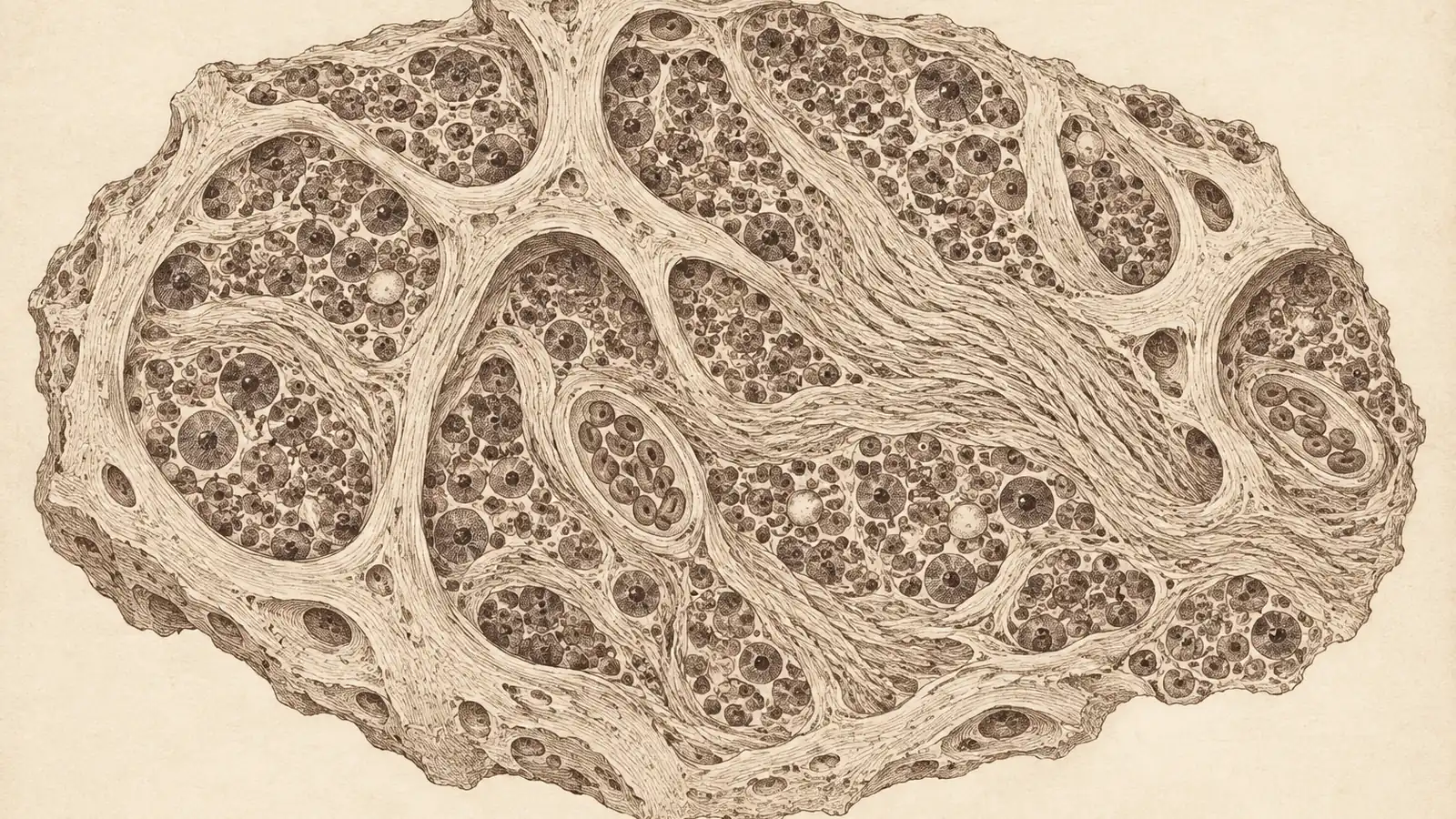
I had always pictured the pre-cancer hiding in aging blood as a seed problem. One stem cell picks up a selfish mutation, crowds out its neighbors for a few decades and maybe, eventually, tips into leukemia, which made the mutant cell the villain and the marrow around it furniture. Then I read a map of living marrow showing that furniture already inflamed and starting to lay down scar tissue, with no cancer anywhere in sight, and I had to set my tidy picture down.
I was surprised to observe such pronounced remodeling of the bone marrow microenvironment already in individuals with CHIP
The map arrived on September 30 in Nature Immunology, where researchers profiled bone marrow from people carrying clonal hematopoiesis cell by cell. The loudest signal wasn’t coming from the mutant clone. It was coming from the neighborhood around it.
Clonal hematopoiesis of indeterminate potential, CHIP for short, is one of the most common things that happens to blood as we age. A blood stem cell acquires a mutation, its descendants expand into a detectable clone, and you feel nothing. By the figures summarized alongside a 2025 marrow study, it turns up in about 10 to 20 percent of adults over 60 and in nearly 30 percent of people over 80. It is not benign scenery either: carriers are 10 times more likely to develop a blood cancer and face double the odds of cardiovascular disease and early death. A 2023 review in Translational Research adds the number I keep coming back to, that roughly 42 percent of patients with a blood cancer already carried these mutations before their diagnosis. For years, all of that risk has been pinned on the mutation itself.
| Measure | Share |
|---|---|
| of blood cancer patients carried these mutations before diagnosis | roughly 42 percent |
So the researchers went to the scene. They took fresh marrow from 15 donors aged 52 to 84 who were having elective hip replacements, and instead of grinding each sample into an average, they read the gene activity of individual cells. In the CHIP marrow they found what they call fibro-inflammatory rewiring: a coordinated TNF-alpha inflammatory state running through the blood progenitors, the monocytes and the stromal support cells all at once, while the mesenchymal and vascular cells cranked up collagen and extracellular-matrix programs, the early machinery of scarring. Fibroblasts, the cells that lay down scar, were markedly expanded, and they had picked up programs resembling cancer-associated fibroblasts, the supportive stroma a tumor builds around itself, rewiring local signaling through IL-6, TGF-beta and collagen-integrin pathways. Nobody in this marrow had cancer, yet the scaffolding was behaving as though it expected to host one.
One detail stopped me cold: the fibroblast expansion showed up regardless of which mutation the clone carried. Wait, why would cells that carry none of the mutation be the ones swelling in number? If the clone were simply barking orders, I’d expect the response to depend on what the clone was, and it didn’t.
A separate 2025 study in Nature Communications, which compared marrow from 35 healthy controls, 17 CHIP carriers and 32 patients with myelodysplastic syndrome (MDS, the next step toward leukemia), offers a mechanism that fits. In CHIP, a distinct population of inflammatory stromal cells starts edging out the ordinary stromal cells whose job is to cradle blood stem cells, and these newcomers become more common still in MDS. According to the researchers’ account, they pour out interferon-induced cytokines and chemokines that pull in interferon-responsive T cells, which then pump the inflammation higher, so the loop feeds itself. One of the team, Maksim Kholmatov, called it quite surprising that the mutant cells showed no direct inflammatory effect. “I was surprised to observe such pronounced remodeling of the bone marrow microenvironment already in individuals with CHIP,” said Judith Zaugg, another of the researchers. By the MDS stage, the diseased stem cells could no longer coax stromal cells into making CXCL12, the homing signal that keeps healthy blood production anchored in place.
Once you see a loop instead of a chain of command, older findings start to line up. Inflamed marrow isn’t neutral ground, because it favors particular clones. In work summarized in the Translational Research review, stem cells lacking TET2, one of the most common CHIP genes, churn out IL-6, and that same cytokine sharpens their competitive edge and helps them resist dying, so they thrive in exactly the environment they help create. Two American Society of Hematology abstracts make the point in their titles: marrow environmental alterations underlie proliferative clonal expansion, and the microenvironment dictates the progression of clonal hematopoiesis through stromal-macrophage crosstalk. Seed and soil are shaping each other, and nobody can yet say which one moved first.
That last uncertainty is where I want to be careful, because the temptation to overshoot here is enormous. The Nature Immunology map comes from 15 donors in total, captured at a single moment, and a snapshot can’t tell you whether the inflammation came before the clone or after it. Nothing in it tells you to swallow an anti-inflammatory on a Tuesday morning, and I wouldn’t hand my marrow to a drug on the strength of one cross-sectional picture.
What the work does change is where the curiosity should point. If the environment is an active participant rather than a backdrop, the most modifiable part of the picture moves to the center. Chronic inflammation is precisely what lifestyle presses on, and a 2022 review in Toxicologic Pathology lays out how diet-induced obesity and exercise each reshape blood production and the marrow niche. That review never touches CHIP, so this is a research question rather than a prescription, and anyone who tries to sell you a “marrow detox” off these papers is the first voice to tune out.
I’m not asking for a marrow biopsy I don’t need, and I’m not buying a pill. I’m keeping the weekly runs I keep threatening to skip and watching the slow creep of my waistline, because body fat and exercise are the two levers with a published record of reaching the marrow, and they’re the only bets on this table I can place myself.
Sources
- Nature Immunology: Prefibrotic bone marrow microenvironment is a hallmark of clonal hematopoiesis (2026)
- European Genome-Phenome Archive: study record and donor cohort for the CHIP marrow profiling
- Nature Communications: Prummel et al., inflammatory stromal and T cells remodel the marrow niche in CHIP and MDS (2025)
- Translational Research: Xie et al., clonal hematopoiesis and bone marrow inflammation (2023)
- ScienceDaily: inflammatory stromal and T-cell remodeling of marrow in CHIP and MDS (2025)
- Blood (ASH 2025): bone marrow environmental alterations underlie proliferative clonal expansion
- Blood (ASH 2024): bone marrow microenvironment dictates the progression of clonal hematopoiesis
- Toxicologic Pathology: how lifestyle affects hematopoiesis and the bone marrow microenvironment (2022)