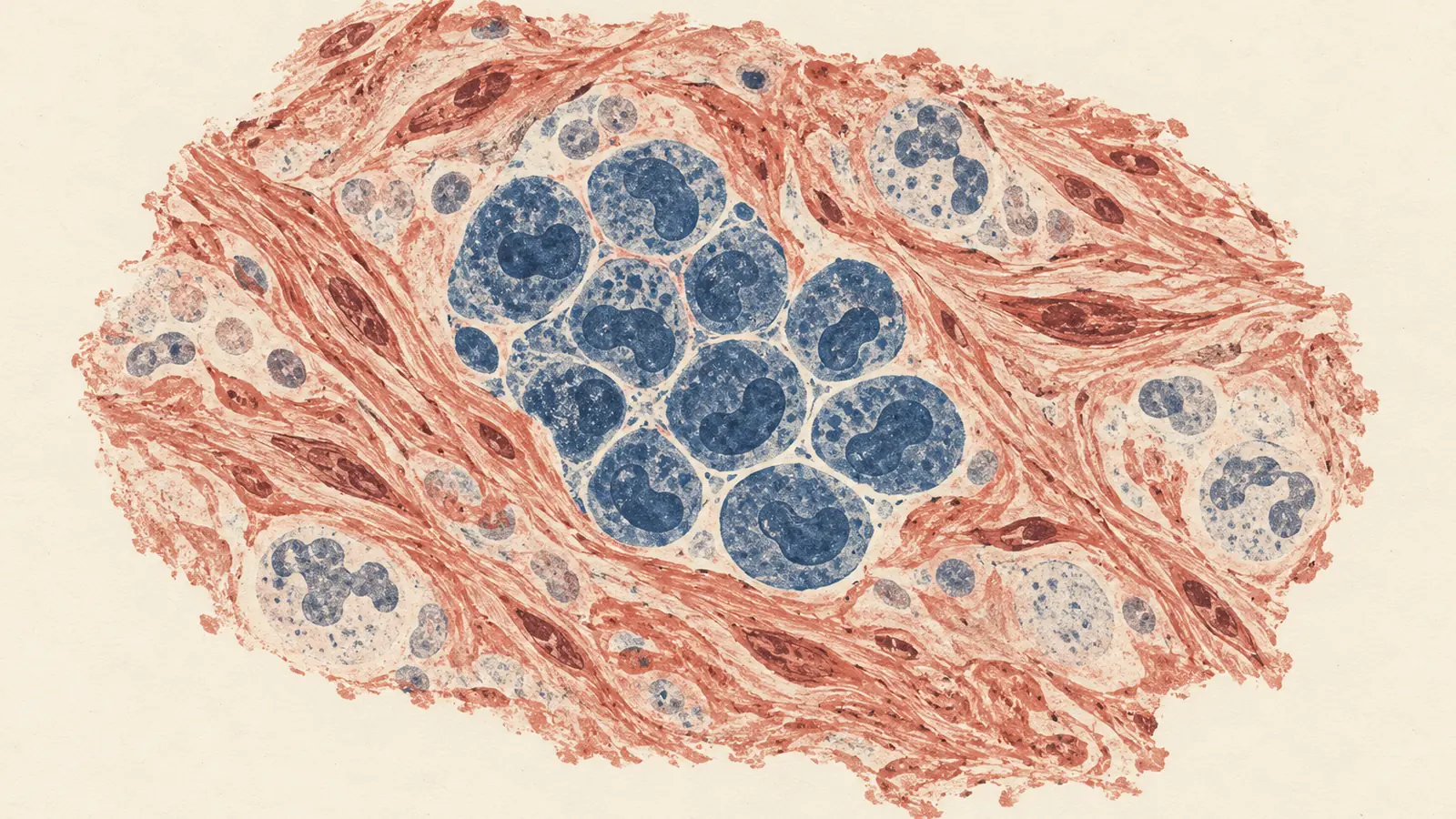
For years I filed the mutations that pile up in aging blood under one word: graffiti. Harmless marks, a typo here and there, proof that time had walked through your bone marrow and left a little mess on its way out. Then I read the new marrow maps, and graffiti stopped feeling like the right word. Renovation fits better, and I’m not sure I like who’s holding the hammer.
a competitor digging a moat and filling it with something only it can swim in
The condition is called clonal hematopoiesis. Once it crosses a formal threshold, with a mutation turning up at a variant allele frequency of at least 2 percent, it earns the acronym CHIP. One of your blood-forming stem cells picks up a mutation, most often in DNMT3A, TET2 or ASXL1, and out-competes its neighbors until a measurable slice of your blood carries that one cell’s signature. It’s common. Early large studies found it in roughly 10 to 15 percent of people 70 and older, and once sequencing got more sensitive the count climbed past half. For a long time the clone was treated as a passenger with a bad reputation, flagged because it nudges up your odds of heart disease and blood cancer but otherwise just sitting there, waiting.
The passenger, it turns out, may have been redecorating. On September 30, Nature Immunology ran a research highlight titled Clonal blood reshapes its home, built on the idea that fibroblast-rich inflammatory pockets in the marrow may help mutant stem cells persist. Behind it sits a preprint from Toronto’s Princess Margaret Cancer Centre that mapped the marrow of CHIP carriers cell by cell and in physical space. The fibroblasts, the cells that normally lay down the marrow’s structural scaffolding, had multiplied and drifted into states that look uncomfortably like the cancer-associated fibroblasts propping up solid tumors. Mesenchymal and blood-vessel cells had cranked up collagen production. When the team looked at where everything physically sat, they found fiber-rich zones packed with active fibroblasts, macrophages and lymphoid cells, lit up with TGF-beta and TNF signaling. The authors call these spatially confined inflammatory hubs, and they call the whole fibro-inflammatory remodel a hallmark of CHIP. I’d call them little walled gardens of inflammation, growing in the same marrow that’s supposed to be quietly making your blood.
A Nature Communications study put harder numbers on it. Working across 84 bone marrow donors (35 age-matched healthy controls, 17 CHIP carriers and 32 people with myelodysplastic syndromes, or MDS, the marrow disorder that can tip into leukemia), the group found a stromal cell studded with inflammatory receptors like CD44 and IL1R1 and pumping out the cytokines CXCL8 and CCL2. The authors describe it as present exclusively in CHIP and MDS and nearly absent in healthy marrow, though their single-cell profiling covered only three CHIP donors and the cell turned up in two of them. Further along the road to MDS the picture darkens: interferon-responsive killer T cells move in, and the stroma makes less CXCL12, the signal healthy stem cells lean on to stay anchored. In a dish, stem cells from controls and CHIP carriers could still coax CXCL12 out of the stroma, while stem cells from MDS marrow had lost the knack.
Wait, though. Why would any cell thrive in a nest this fouled? Inflammation is supposed to grind stem cells down, and I couldn’t see the upside for the mutant until I read a study that sampled marrow from 195 people undergoing hip replacement. Of them, 57, or 29.2 percent, carried a clone. Inside each marrow sample, the researchers then compared the mutant stem cells with the unmutated siblings sitting right beside them, and the mutants were barely listening to the inflammation. DNMT3A and TET2 mutant cells showed muted TNF-alpha and NF-kB signaling, weaker IL-1 and interferon responses, and fewer of the gene signatures of an aged stem cell. TET2 mutants had even turned up A20, a molecular brake on the NF-kB pathway, as if they’d fitted themselves with noise-cancelling headphones.
| Measure | Share |
|---|---|
| of hip-replacement patients sampled | 29.2 percent |
And the mutants were winning. In those marrows a single DNMT3A clone made up anywhere from 3.4 to 73.3 percent of the most primitive stem and progenitor pool, and TET2 clones grew 2.5- to 3-fold larger among granulocyte-monocyte progenitors, the cells headed for frontline immune duty, than among the stem cells they came from.
of the stem and progenitor pool, single DNMT3A clones
- Lower bound
- 3.4
- Upper bound
- 73.3
Put the two halves together and you get a model I can’t shake. The marrow fills with inflammation that wears down normal stem cells, and the mutant clone barely registers it. If the clone is also helping build that inflammation, which the maps hint at and nobody has proven, then it was never a passenger. It’s a competitor digging a moat and filling it with something only it can swim in.
What we have so far is the crime scene, not the security footage. Every one of these studies is a snapshot of human marrow at a single moment, and the Toronto fibroblast work hasn’t cleared peer review. The direction is still open. The Nature Communications authors themselves suggest a pre-existing inflammatory environment may act as a selective force that favors mutant cells, even as their own co-culture experiments showed MDS cells can stir up inflammatory stroma directly. My bet is a loop that feeds itself both ways, but that’s a bet, and the experiment that settles it hasn’t been run.
That open question matters, because there’s a drug waiting at the end of this story. The review literature flags IL-1-beta as a cytokine these clones may amplify, and the evidence that blocking IL-1 helps in clonal hematopoiesis is still mouse work. The best human data come from CANTOS, a trial of Novartis’s IL-1-beta antibody canakinumab that ran on Novartis grants. An exploratory genetic substudy found clones in 338 of 3,923 sequenced patients, and TET2 carriers on the drug had a hazard ratio for major cardiac events of 0.38 (95 percent confidence interval 0.15 to 0.96). That looks dramatic until you hit the fine print: the test of whether TET2 carriers actually responded differently from everyone else came back at p = 0.14, the analysis had roughly 24 percent power, and the author list is heavy with Novartis research staff, two of whom disclosed holding company shares.
| Result | Value (HR) | Lower bound | Upper bound |
|---|---|---|---|
| TET2 carriers on canakinumab | 0.38 | 0.15 | 0.96 |
You can see where the pitch goes from here. Screen huge numbers of healthy older people, find the clone carriers, and put them on a lifelong anti-inflammatory injection. The burden of proof sits squarely on whoever wants to medicate millions of people with no symptoms for something more than half of 70-year-olds carry on a sensitive test. A biomarker isn’t a disease, and inflammation you can image isn’t a prescription yet.
Not every clone is the same clone, either, which keeps me from catastrophizing. When researchers compared 217 extremely frequent blood donors, all men over 60 with more than a hundred lifetime donations, against 212 occasional donors, they found no significant difference in the overall rate of clonal hematopoiesis. The flavor differed. DNMT3A mutations enriched in the frequent donors expanded in culture rich in erythropoietin, the hormone that surges every time you lose blood, while the leukemia-associated R882 variant expanded under interferon-gamma, an inflammatory signal. The donors showed no excess of the known pathogenic variants, though the authors pointedly decline to make any definitive statement on safety. In the dish, the environment chose which mutation won, which is the marrow-remodeling story told from the other side: the soil decides what grows.
So here’s where I’ve landed. I’m not paying for a CHIP screen, because a clone I can’t change would only hand me a number to lie awake over. I’m going to stop treating inflammation as a wellness buzzword and start picturing it as these maps show it, as soil that something in my marrow may be quietly reshaping for its own benefit. And if anyone ever offers me a lifelong IL-1 blocker on the strength of a clone and an exploratory subgroup, I’ll ask for the interaction p-value before I roll up my sleeve.
Sources
- Nature Immunology research highlight: Clonal blood reshapes its home (2026)
- Aguilar-Navarro, Edun and Tikhonova, Prefibrotic Bone Marrow Microenvironment is a Hallmark of Clonal Hematopoiesis (2026 preprint)
- Prummel et al., Inflammatory stromal and T cells mediate human bone marrow niche remodeling in clonal hematopoiesis and myelodysplasia, Nature Communications (2025)
- Selective advantage of mutant stem cells in human clonal hematopoiesis is associated with attenuated response to inflammation and aging
- Svensson et al., TET2-Driven Clonal Hematopoiesis and Response to Canakinumab, JAMA Cardiology (2022)
- Karpova et al., Clonal hematopoiesis landscape in frequent blood donors, Blood (2025)
- Review: Clonal hematopoiesis and its impact on the aging osteo-hematopoietic niche