Growth hormone has a reputation problem. It is the stuff aging men pay clinics to inject, the black-market vial in every bodybuilding forum, the line item on every longevity protocol that promises to sell you back your twenties. So the thing that stopped me cold in a new circuit-mapping study out of Berkeley is embarrassingly simple: your body already makes the exact same molecule, on its own schedule, for nothing, and it does most of that work in the deep-sleep hours you are almost certainly shortchanging.
The study ran in mice, and I want to be honest about that up front, because the wellness marketing built on top of it is not. Somebody is trying to turn a sleep-regulated repair signal into a subscription, and this paper is about to get quoted as the receipt. The team in Yang Dan’s lab at UC Berkeley slid electrodes into mouse brains, flashed light at specific clusters of neurons in the hypothalamus, and watched what happened to hormone release across the sleep-wake cycle. Mice are useful here for a mundane reason: they sleep in short scattered bursts, so you get to watch the machinery cycle over and over in a single afternoon. What they found, published in Cell in June 2025, is the actual wiring diagram for something physiologists have described for fifty years without being able to explain.
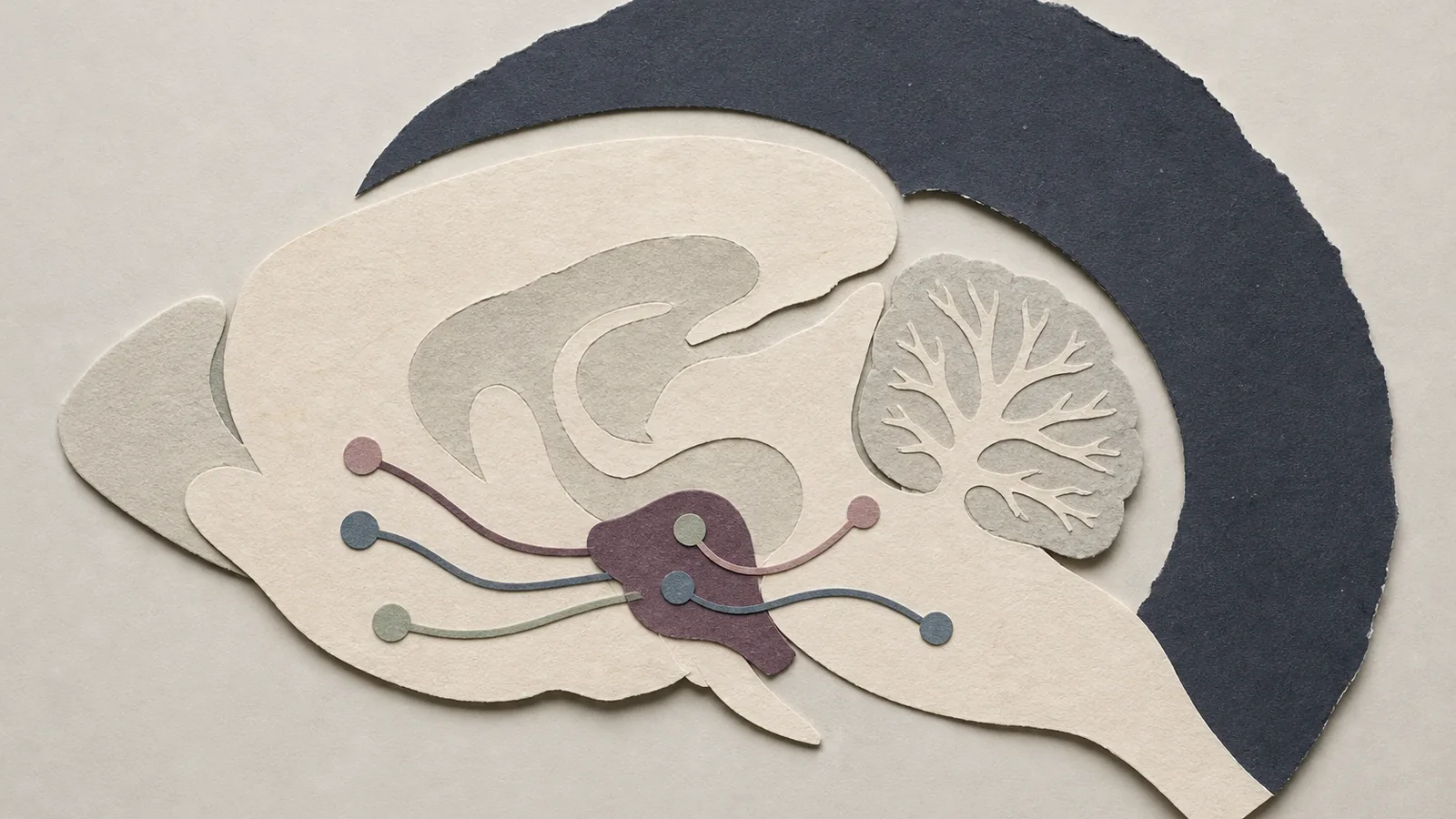
Here is the setup. The hypothalamus does not make growth hormone. It runs the switch for the gland that does, the pituitary, and it does it with two tiny peptide hormones that argue over the dial. One, called GHRH, tells the pituitary to pour growth hormone out. The other, somatostatin, tells it to stop. The Berkeley group showed these two neuron populations run on different schedules depending on which kind of sleep you are in: across REM sleep both surge together in a way that nets out to more growth hormone, while in non-REM sleep somatostatin backs off and GHRH nudges up only moderately. Either way the balance tips toward release. That is why the deepest, earliest stretch of your night is when your body does its building.
And then the loop turns on itself, which I did not see coming. Growth hormone does not just get released during sleep. It feeds back and pushes you toward waking up. As it slowly accumulates through the night, it raises the excitability of the locus coeruleus, the brainstem’s arousal switch, nudging you toward the surface. Wait, why would the hormone your body pumps out to repair itself in sleep also be the one prodding you awake? Because the loop is self-correcting. When the locus coeruleus gets pushed too hard, the researchers found, it flips and promotes sleepiness instead. Growth hormone, it turns out, is both the night-shift construction crew and part of the alarm clock. “Sleep drives growth hormone release, and growth hormone feeds back to regulate wakefulness,” co-author Daniel Silverman put it, “and this balance is essential for growth, repair and metabolic health.”
That is a beautiful piece of biology. It is not what the aggregator headline promised. “Builds muscle, burns fat, boosts the brain” is doing an enormous amount of load-bearing work for a study that mapped a circuit in rodents and did not put a single mouse on a scale to measure fat loss or on a treadmill to measure strength. The Berkeley team does say growth hormone helps build muscle and bone and reduce fat, and hedges that it “may also” help cognition, but that comes from decades of separate human physiology, not from this experiment. When a mechanistic mouse paper gets marketed with the exact language a supplement funnel would use, that gap is worth naming out loud, especially in a field where “growth hormone” and “anti-aging” have been fused into a very profitable, very poorly supported product category. Injecting growth hormone to chase youth is not what this study endorses. If anything it points the other way.
Because the free version already exists, and the human data on it is old and solid. In healthy men, roughly 70 percent of the growth-hormone pulses that occur during sleep line up with slow-wave deep sleep, and the single largest pulse of the day fires shortly after you fall asleep, riding that first descent into deep sleep. Push the deep sleep back or break it up at the start of the night, and that nocturnal surge shrinks: the release is tied to sleep onset and slow-wave sleep specifically, not just to the clock reading midnight. You cannot buy that pulse back in a vial without buying the risks that come with exogenous hormone. You earn it by protecting the front half of your night.
The Berkeley team floated the locus coeruleus feedback as a possible drug target, a “handle” to treat sleep disorders tied to diabetes, Parkinson’s, and Alzheimer’s. Notice how fast a mouse circuit becomes a pipeline pitch. Drug-target language is not proof that a sedative, a sleep hack, or a growth-hormone protocol reproduces the biology, because knocking your brain offline is not the same event as letting it descend into the slow waves that open the growth-hormone tap. This study did not test a single sleeping pill either way.
So this is my conclusion. I am not going to chase a growth-hormone protocol, and I am definitely not injecting anything a clinic wants to sell me on a subscription. I am going to treat the first ninety minutes of my night like the appointment it apparently is: dark, cool, uninterrupted, phone in another room. My hypothalamus already runs a better longevity clinic than any of the ones with a waitlist. I just have to stop standing in its way.
Sources
- UC Berkeley News – “Sleep strengthens muscle and bone by boosting growth hormone levels. UC Berkeley researchers discover how.”
- Cell – “Neuroendocrine circuit for sleep-dependent growth hormone release” (2025)
- PubMed – “Neuroendocrine circuit for sleep-dependent growth hormone release,” Cell (2025), PMID 40562026
- ScienceDirect – Van Cauter & Plat, “Physiology of growth hormone secretion during sleep” (GH pulses and slow-wave sleep in humans)
- PubMed – “The significance of sleep onset and slow wave sleep for nocturnal release of growth hormone and cortisol,” PMID 3406323
- EurekAlert! – UC Berkeley release, “Sleep strengthens muscle and bone by boosting growth hormone levels. Here’s how”
- ScienceDaily – “Scientists discover the deep sleep circuit that builds muscle, burns fat, and boosts the brain”