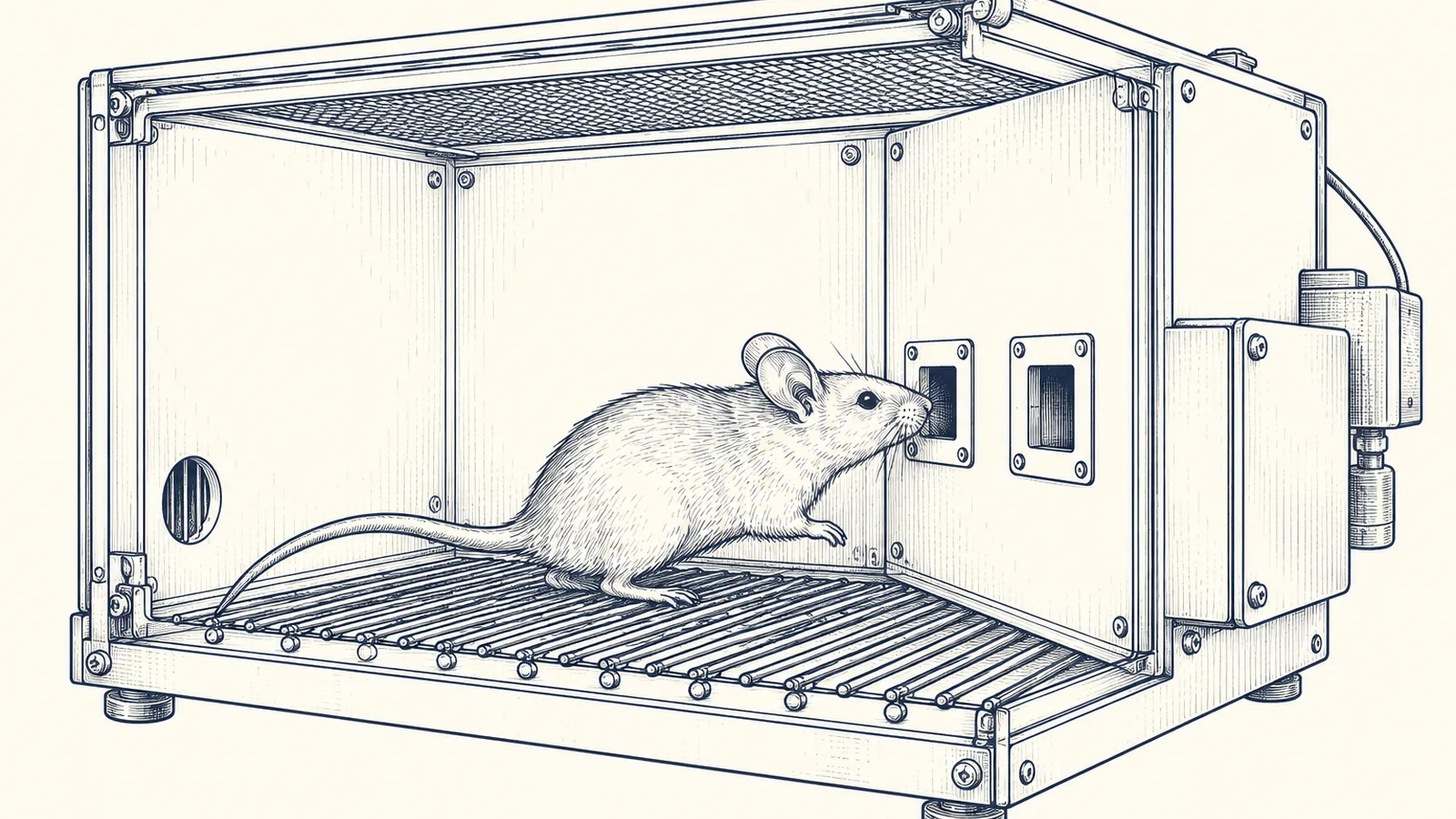
I had cannabinol filed under “harmless.” In my head it was the mellow one, the cannabinoid THC turns into when it sits in a jar too long, the one that ends up in sleep gummies because it supposedly won’t get you high. So I wasn’t ready for a mouse trained to recognize THC to get a dose of CBN and give the THC answer.
CBN is everywhere right now. Gummies, tinctures, capsules, and it's marketed as a safe, herbal sleep supplement.
That mouse comes from a paper slated for the November issue of Drug and Alcohol Dependence. Lead author Olivia Vanegas, senior author Steven Kinsey of the University of Connecticut and their colleagues trained mice to tell an injection of THC from a blank one, then swapped in CBN. The animals responded as though they’d gotten THC; in the paper’s words, CBN “fully substituted” for it. A separate group of mice got CBN twice a day for five days so the team could look for the two hallmarks of physical dependence, a body that adapts to the drug and a body that protests when the drug’s action is cut off. They found both.
Dependence is the precise word here. Nobody measured craving, or whether a mouse would work to get more CBN, so this isn’t an addiction finding, and the university’s release says plainly that the results don’t establish dependence or withdrawal in people. What they do establish in mice is plenty.
According to the study’s abstract, over those five days the mice grew tolerant to three classic cannabinoid effects: catalepsy (a frozen stillness), a dulled response to pain and a drop in body temperature. They had also become less responsive to WIN 55,212-2, a synthetic cannabinoid they had never been given. On day six the researchers injected rimonabant, which blocks the brain’s main cannabinoid receptor, and the CBN mice showed head twitches, paw tremors and more struggling when held by the tail. That’s a forced withdrawal, and a harsh one, because rimonabant strips the drug’s signal from the receptor in a single shot in a way that skipping tonight’s gummy wouldn’t. It’s the standard way to ask whether a body has come to lean on a drug, and here the answer was yes.
Wait, why would blocking a receptor make an animal shake? I had to sit with this one. The usual explanation goes like this: for five days CBN kept nudging those receptors, and the nervous system compensated by turning its own sensitivity down, the way you lower the volume on a song that never stops. Then rimonabant cut the signal off all at once, leaving a system still tuned for constant input with none. The cross-tolerance is what makes me take that picture seriously. If the mice had simply gotten faster at breaking CBN down in the liver, a different molecule like WIN 55,212-2 should have hit as hard as ever, and it hit softer, which points to a change in the cannabinoid system the two drugs share. That’s an inference rather than a measurement, since the abstract reports behavior, not receptor counts.
There’s a wrinkle I keep turning over. Given together with THC, CBN attenuated THC’s psychoactive effects in these mice, and the rimonabant dose the team tested blunted CBN’s effects less than it blunted THC’s. So how does one molecule pass for THC in a trained mouse, turn THC down when the two arrive together, and partly slip past THC’s blocker? My guess, and it’s only a guess, is that CBN is a weaker partner at the same receptor with some other route into the system. The abstract doesn’t settle it.
The release adds two findings that pull in opposite directions. CBN reduced inflammation, including at lower doses that weren’t psychoactive, and the release allows that it may have medical applications. But “during a simulated bacterial challenge, CBN reduced the body’s ability to defend itself.” In mice, the compound people take to switch off for the night also turned down that defense.
Seven nights of sleep diaries
None of this would matter much if CBN were a lab curiosity. Steven Kinsey described the shelf bluntly in the release: “CBN is everywhere right now. Gummies, tinctures, capsules, and it’s marketed as a safe, herbal sleep supplement.” So I went looking for the human evidence under that marketing, and it’s thin and short.
The larger trial is a double-blind, placebo-controlled study in Experimental and Clinical Psychopharmacology, run, according to PsyPost, by researchers at Canopy Growth, the Ontario cannabis company. It gave 321 adults who rated their sleep as poor 20 mg of CBN, CBN-CBD combinations or placebo for 7 nights. On the main measure, overall sleep quality, CBN alone did not significantly beat placebo, though it cut nighttime awakenings by about 0.5 per night and lowered a sleep-disturbance score by 1.36 points. Time to fall asleep, time awake after first dropping off and daytime fatigue showed no difference, everything was self-reported, and withdrawal wasn’t examined.
The other trial people cite is a 20-person crossover pilot in Health Science Reports, funded in part by Sanna Science Inc., which also supplied the product and the placebo. That softgel wasn’t plain CBN: each one held 6 mg of CBN, 10 mg of CBD and 3 mg of THC. On insomnia severity, its edge over placebo came in at p = 0.70, nowhere near significant. The authors themselves note that products marketed for sleep typically contain 5 mg of CBN or less.
Stack those together and you get one week of self-reported diaries from a cannabis company’s trial that missed its main measure, plus a small, company-supplied pilot of a blend that contains THC. “The marketing of minor cannabinoids is pretty wild right now,” Vanegas said. I’m inclined to agree with her.
Made in a flask, sold as a plant
The “it’s just aged cannabis” story deserves a second look too. CBN does form as THC degrades. But US Patent 11,667,619, originally assigned to Gaia Botanicals, describes making CBN from hemp-derived CBD by reacting it with iodine in toluene and then purifying it by chromatography. A patent can’t tell you how any particular gummy was made, but it does show CBN can come out of a reactor rather than an old jar of flower.
That matters because Congress has rewritten the federal definition of hemp. According to the Congressional Research Service, the new definition, enacted in P.L. 119-37, excludes products containing cannabinoids that “are capable of being naturally produced” but were “synthesized or manufactured outside the plant,” and it counts “other cannabinoids with similar effects” toward its THC limits. The exclusion for certain synthetic cannabinoid products takes effect November 12, 2026, and a later stopgap law, P.L. 119-103, pushed other portions of the definition to December 11.
The same law ordered the FDA to publish, within 90 days of enactment, lists of cannabinoids, including those with effects similar to THC. As of the CRS update dated September 28, 2026, that list had not been published. It’s the document a gummy maker, a store owner or a parent would need to know whether CBN lands in the “similar effects” bucket. A mouse study isn’t a legal determination. Still, a university lab has now shown CBN fully substituting for THC in trained mice, while the agency told by law to sort this out had, as of that update, produced nothing.
The burden belongs with the people selling CBN for nightly use, not with the people asking questions. The longest dosing period in either human trial was 10 days, and the larger one never looked at what happens when people stop. Nobody in those trials took CBN every night for a year and then quit to see what their sleep looked like the week after. Until someone runs that study, “safe” on a nightly sleep supplement is a sales pitch, not a finding.
I won’t keep a CBN gummy on my nightstand as a nightly habit until someone shows me what a year of them, and the week after stopping, does to a person.
Sources
- Vanegas, Marusich, Maturano, Sarlah and Kinsey, Tolerance, physical dependence, and Δ9-THC-like interoceptive effects of cannabinol in mice, abstract (2026)
- Drug and Alcohol Dependence, Vanegas et al., 288:113341 (2026)
- ScienceDaily, University of Connecticut release on CBN tolerance and withdrawal in mice (2026)
- Bonn-Miller et al., Experimental and Clinical Psychopharmacology, CBN with and without CBD on sleep (PubMed)
- PsyPost, trial details, Canopy Growth affiliation and limitations
- Hausenblas, Hooper and Lynch, Health Science Reports, CBN/CBD/THC softgel crossover pilot (2025)
- Congressional Research Service, IF13136 on the federal definition of hemp (updated Sept. 28, 2026)
- US Patent 11,667,619, Synthesis and purification of cannabinol from cannabidiol